Calories in Starbucks Banana Loaf: Complete Nutrition Guide
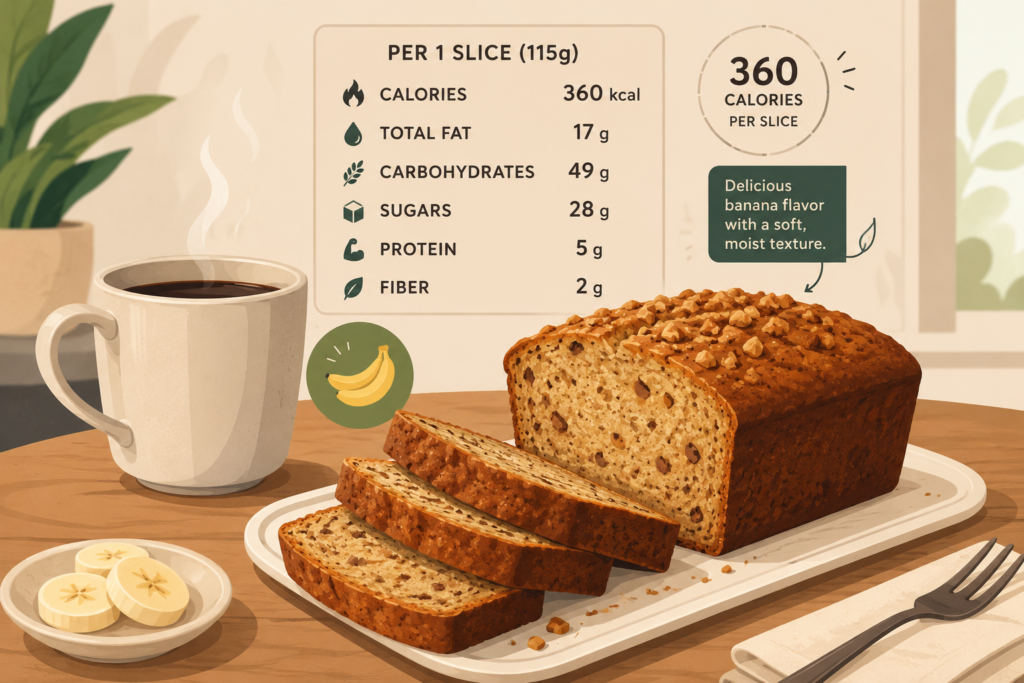
A single serving of Starbucks banana loaf — one slice, about 113 grams — contains 380 calories, according to nutrition data sourced from Starbucks’ published disclosures. That serving also carries 20 grams of fat, 46 grams of carbohydrates, 26 grams of sugar and 6 grams of protein.
If you searched for the calories in Starbucks banana loaf because you’re deciding whether to order it, planning your day’s food, or just curious what’s actually in that dense, nutty slice by the pastry case, you’re in the right place. This guide breaks down the full nutrition label, explains exactly what “one serving” means, compares the loaf with other Starbucks bakery items, and shows how it can fit into different daily calorie goals — without pretending there’s one universal “healthy” answer for every reader.
Starbucks currently lists this item on its menu as the Banana, Walnut & Pecan Loaf, though most customers still search for it as banana bread or banana loaf. We’ll use both terms throughout, since they refer to the same product line, and we’ll flag where naming and recipe changes over the years have caused some confusion online.
How Many Calories Are in Starbucks Banana Loaf?
The short answer is 380 calories per standard slice. Here’s the complete nutrition breakdown for one serving, based on Starbucks’ current published nutrition information:
| Nutrition | Amount per serving |
|---|---|
| Serving size | 1 slice (113 g) |
| Calories | 380 |
| Total fat | 20 g |
| Saturated fat | 3 g |
| Trans fat | 0 g |
| Cholesterol | 50 mg |
| Sodium | 300 mg |
| Total carbohydrates | 46 g |
| Dietary fiber | 2 g |
| Total sugars | 26 g |
| Protein | 6 g |
A quick note on accuracy: nutrition figures for bakery items can shift when a chain updates a recipe, changes a supplier, or adjusts portion sizes, and values can also vary slightly by country. You may see older listings online showing around 420 calories for “Banana Nut Bread” — that reflects a previous version of the recipe and product name. For the most current figure at your specific location, Starbucks’ official nutrition page or app is always the definitive source, and our Starbucks nutrition calculator is kept in sync with published data so you can double-check before you order.
Starbucks Banana Loaf Nutrition Facts
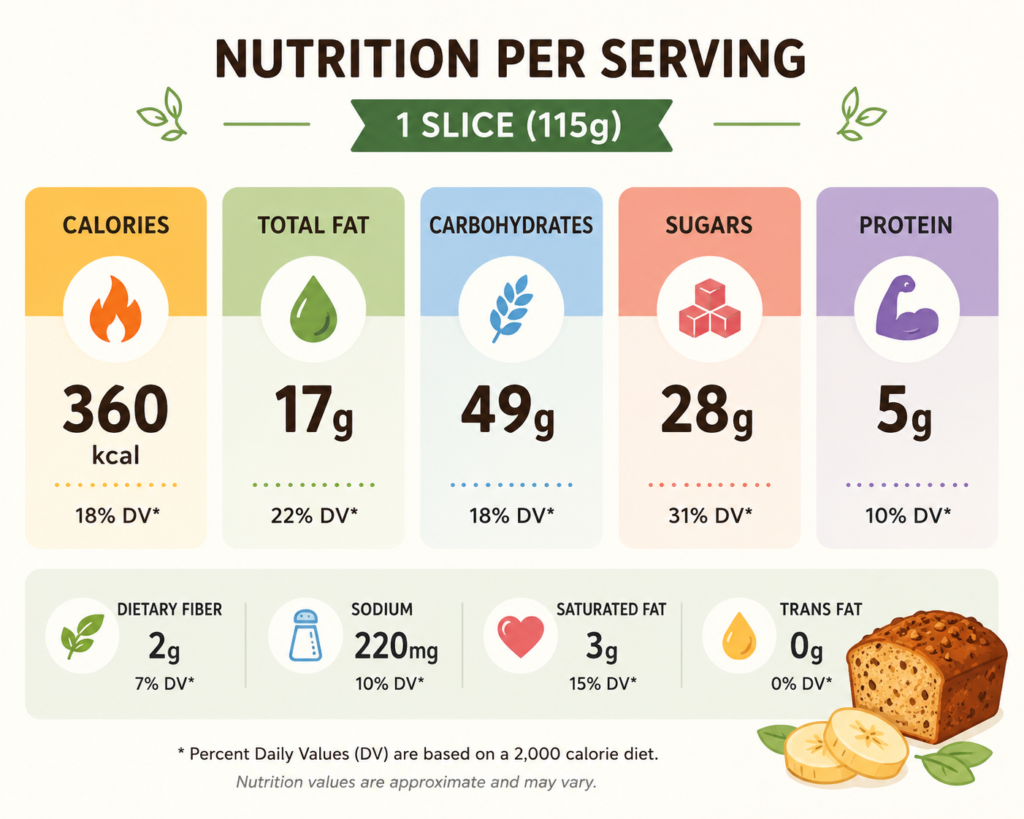
Numbers on a label only tell part of the story. Here’s what each figure actually means for the person eating the slice.
Calories
At 380 calories per serving, Starbucks banana loaf nutrition sits in the mid-to-upper range for a coffee shop bakery item — heavier than a plain croissant, lighter than some layered cakes. Calories measure the energy the food provides; how that fits your day depends on your total intake, activity level, and what else you’re eating.
Fat
The loaf has 20 grams of total fat, with 3 grams of it saturated. Fat here comes mainly from the soybean and/or canola oil in the batter, plus the eggs and the walnuts and pecans folded into the loaf. Nuts contribute unsaturated fat alongside a small amount of protein and fiber, which is part of why this item’s saturated fat count is relatively modest compared with butter-heavy pastries.
Carbohydrates
Total carbohydrates land at 46 grams per slice, covering both the starch from the flour and the sugar from the batter and mashed banana. If you’re counting carbs for any reason — training fuel, blood sugar awareness, or general tracking — this is the number most worth watching, since carbohydrates make up roughly half the loaf’s calories.
Sugar
Starbucks banana loaf sugar content is 26 grams per serving. That’s a mix of added sugar from the recipe and natural sugar from ripe banana. For context, the American Heart Association suggests most adults keep added sugar under about 25–36 grams a day, so a single slice can represent a meaningful share of that target. This doesn’t make the loaf off-limits — it simply means readers watching sugar intake may want to consider it alongside the rest of their day, not in isolation.
Protein
Starbucks banana loaf protein comes in at 6 grams per slice. That’s a modest amount — roughly what you’d get from one egg — and on its own isn’t enough to make the loaf a filling, protein-forward snack. Pairing it with a protein source like a hard-boiled egg, Greek yogurt, or a protein-forward drink is one simple way to round out the snack if satiety is a priority for you.
Fiber
The loaf provides 2 grams of dietary fiber per serving, mostly from the banana, flour, and nuts. That’s a small contribution toward the general daily fiber guidance of around 25–30 grams, so it shouldn’t be counted on as a significant fiber source.
Sodium
Sodium sits at 300 milligrams per serving, largely from the baking soda, baking powder, and salt used to structure the batter. That’s about 13% of the commonly cited 2,300 mg daily sodium guideline. It’s not an unusually high number for a baked good, but if you’re tracking sodium closely for medical reasons, it’s worth factoring in alongside your coffee order — some Starbucks drinks and breakfast sandwiches carry meaningful sodium too.
Starbucks Banana Loaf Serving Size
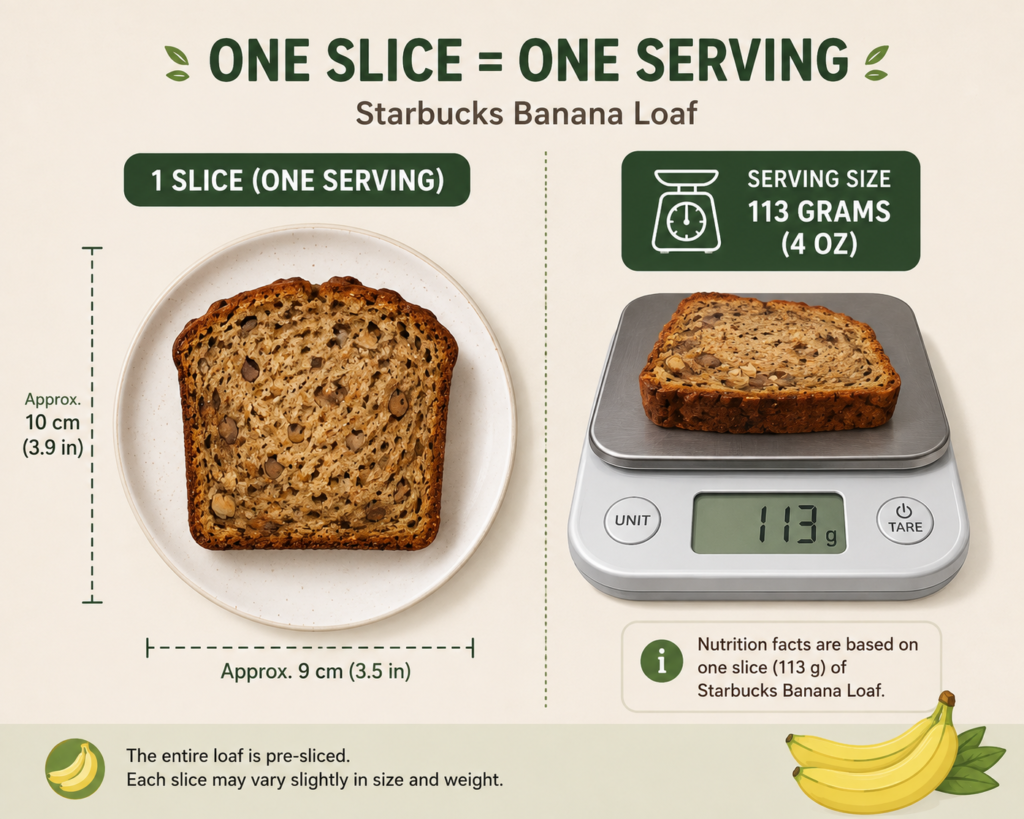
Every number above refers to one slice, weighing about 113 grams (roughly 4 ounces). That’s the standard bakery-case portion Starbucks sells as a single unit — not a whole loaf, and not a half-slice sample.
This distinction matters for a simple reason: comparing calories across foods only works when you’re comparing the same serving size. A dense, nut-studded quick bread naturally has more calories per slice than a light muffin or a small cookie, partly because the slice itself is a heavier portion. When you see wildly different calorie numbers for “banana loaf” across different websites, differences in reported serving weight are one of the most common explanations, alongside recipe or regional differences.
If you ever order a larger or custom-cut portion, or split a slice with someone, the values on the nutrition label won’t apply directly — you’d need to scale them to the actual amount you eat.
Calories in Starbucks Banana Bread vs. Banana Loaf
“Banana bread” and “banana loaf” are two names people commonly use for the same style of product, and in casual conversation, most people mean exactly the same thing whether they say one or the other. Starbucks’ own menu currently lists the item as the Banana, Walnut & Pecan Loaf, which explains why some search results for “Starbucks banana bread calories” pull up the same 380-calorie, 113-gram listing as “banana loaf.”
That said, older nutrition databases and archived pages still reference a product called “Banana Nut Bread,” listed at roughly 420 calories with a slightly different fat and sugar breakdown. That appears to reflect a prior recipe or naming convention rather than a separate item currently on the menu. If you’re comparing numbers from different sources, it’s worth checking the date and serving size on each listing — Starbucks banana bread nutrition figures published years apart may not describe the same product.
The practical takeaway: whether you search “calories in Starbucks banana bread” or “Starbucks banana loaf calories,” you should land on the same current answer — about 380 calories per 113-gram slice — as long as the source you’re checking reflects the present-day menu item.
What Is in Starbucks Banana Loaf?
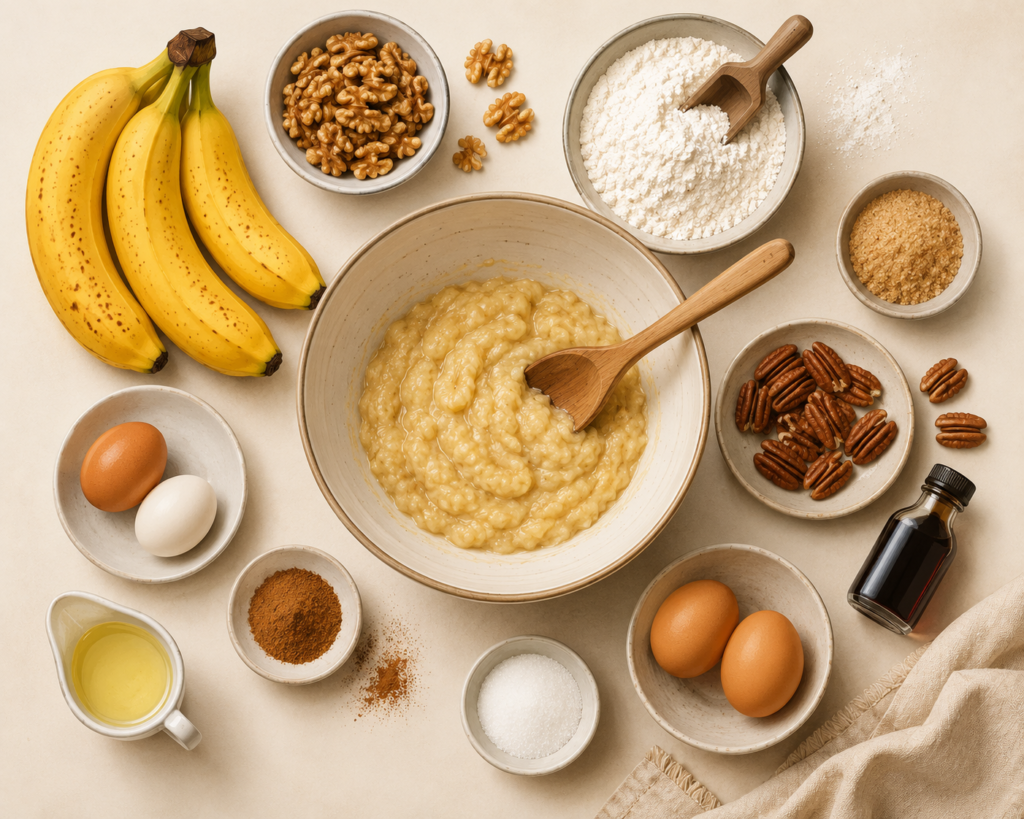
Based on Starbucks’ published ingredient information for the Banana, Walnut & Pecan Loaf, the major components are:
- Bananas — the primary flavor ingredient and a source of natural sweetness and moisture
- Enriched wheat flour — the structural base of the batter
- Sugar — for sweetness and browning
- Soybean and/or canola oil — the main fat source in the batter
- Eggs — for structure, richness, and binding
- Walnuts and pecans — the “nut” component, adding texture, healthy fats, and flavor
- Leavening agents — baking soda and baking powder, which help the loaf rise
- Salt, natural flavor, and spice — for overall flavor balance
This list reflects Starbucks’ standard recipe as disclosed on its official nutrition pages. Recipes and sourcing can change over time or vary slightly between locations, so if you have a specific dietary restriction, it’s worth checking Starbucks’ current, location-specific ingredient listing — Starbucks banana loaf ingredients on the official site or app will always be more current than any third-party summary, including this one.
Starbucks Banana Loaf Allergens
Based on the ingredient list above, Starbucks banana loaf contains several major allergens:
- Wheat/gluten — from the enriched wheat flour
- Eggs
- Tree nuts — both walnuts and pecans are baked directly into the loaf
- Soy — from soybean oil and soy-derived emulsifiers used in the recipe
Starbucks bakery items are prepared in stores that also handle a wide range of other allergen-containing ingredients, and cross-contact is possible even for packaged items. If you have a serious food allergy, don’t rely on this article, or any third-party summary, as your final check. Ask a Starbucks barista for the most current allergen and ingredient information at your location, or check the official Starbucks nutrition page, before ordering.
Is Starbucks Banana Loaf High in Calories?
At 380 calories per slice, Starbucks banana loaf sits toward the higher end of the bakery case, but it’s not the highest-calorie item Starbucks sells, and “high calorie” on its own doesn’t tell you whether something is a good or bad fit for you. A few things to consider:
- It’s a substantial portion. At 113 grams, it’s a heavier single serving than many grab-and-go pastries, which naturally pushes the calorie count up.
- The calories come with some nutritional substance. Between the banana, eggs, and nuts, the loaf isn’t purely refined flour and sugar — it includes some fiber, unsaturated fat, and a modest amount of protein compared with items like plain danishes or sugar cookies.
- Context matters more than a single number. Whether 380 calories is “a lot” depends heavily on the rest of your day — what you’ve already eaten, your typical calorie needs, and how the loaf fits into your broader eating pattern.
Is Starbucks banana loaf healthy? That’s ultimately a personal question shaped by your goals, the rest of your diet, and how often you eat items like this — not something a single nutrition label can answer for everyone. What the label can tell you is exactly what you’re getting, so you can decide for yourself.
Starbucks Banana Loaf Calories Compared With Other Bakery Items
Seeing the banana loaf next to other bakery-case regulars helps put its calorie count in perspective. Figures below reflect standard servings based on published nutrition data and can vary by location.
| Starbucks Bakery Item | Serving Size | Calories |
|---|---|---|
| Banana, Walnut & Pecan Loaf | 113 g (1 slice) | 380 |
| Blueberry Muffin | 99 g (1 muffin) | ~330 |
| Butter Croissant | 62 g (1 croissant) | 250 |
| Birthday Cake Pop | 38 g (1 pop) | 160 |
A few things stand out from this comparison. The banana loaf and the blueberry muffin are fairly close in calories, which makes sense given their similar serving sizes and dense, batter-based structure. The butter croissant, despite being rich in saturated fat from butter, comes in lower overall mainly because the portion itself is smaller. The birthday cake pop is the clear outlier on the low end — but that’s largely a function of its bite-sized portion rather than it being a “lighter” recipe gram for gram.
The lesson here isn’t that any one item is automatically the “better” choice. It’s that portion size drives a large share of the calorie differences you see across a bakery case, which is exactly why checking serving size alongside calories — not calories alone — gives you a much clearer picture.
How Starbucks Banana Loaf Fits Into a Daily Calorie Goal
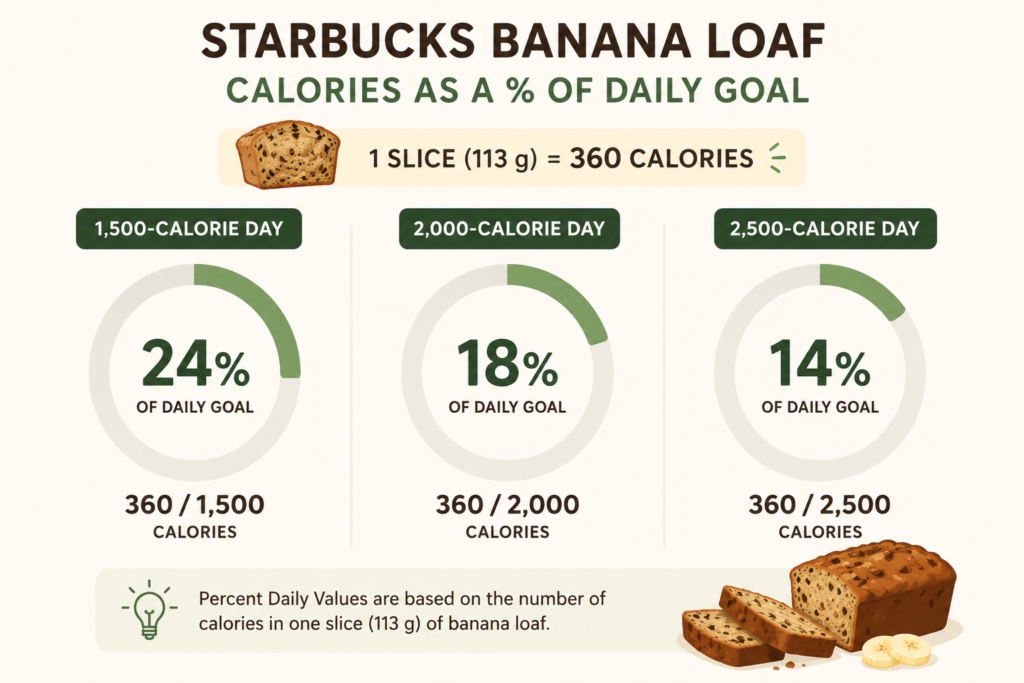
These examples are meant to illustrate proportions, not to serve as personalized dietary advice — everyone’s calorie needs differ based on age, activity level, body size, and goals.
- 1,500-calorie daily target: A 380-calorie slice represents about 25% of the day’s total calories.
- 2,000-calorie daily target: The same slice represents about 19% of the day’s total.
- 2,500-calorie daily target: The slice represents about 15% of the day’s total.
Seeing the loaf as a percentage of a daily target can help you decide how to balance the rest of your meals that day — for example, choosing a lighter lunch or a lower-calorie coffee order if you’ve already had the loaf for breakfast. None of this is about labeling foods “good” or “bad”; it’s simply a way to plan realistically around the numbers.
How to Order a Lower-Calorie Starbucks Snack
If you like the banana loaf but want to manage your overall order’s calorie count, a few practical options can help:
- Compare bakery items before you order. As the table above shows, portion size varies a lot across the case — a birthday cake pop or a piece of fruit may satisfy a sweet craving with fewer calories, though it won’t offer the same texture or staying power as a full slice of loaf.
- Choose a smaller portion where it’s offered. Some locations or mobile-order options allow half-portions of certain bakery items.
- Pair the loaf with a lower-calorie drink. If you’re having a Starbucks drink with your banana loaf, use our Starbucks calorie counter to estimate the calories, sugar, protein, carbohydrates and fat in your customized order — swapping a sugary blended drink for black coffee or a lighter latte can offset a good portion of the loaf’s calories.
- Avoid unnecessary high-calorie add-ons. Skipping butter, cream cheese, or other spreads keeps the loaf’s nutrition profile close to what’s listed on the label.
- Check nutrition information before ordering, not after. You can also use the Starbucks calorie calculator to compare different drink sizes, milk choices, syrups and toppings before ordering, so there are no surprises at checkout.
- Look beyond calories if that matters to you. If you want to look beyond calories, the Starbucks nutrition calculator can help you compare additional nutrition information — sugar, sodium, and caffeine — for customized drinks.
None of these swaps is automatically “healthier” in every sense — a smaller portion still leaves you hungrier, and a black coffee isn’t right for everyone’s taste or routine. They’re simply levers you can pull if lowering total calories is your specific goal for that order.
If you’re building your order around a specific drink, a few of our other guides can help you plan the whole trip rather than just the bakery case. If you’re pairing the loaf with a flavored latte, our guide to calories in vanilla syrup at Starbucks breaks down how much a pump or two actually adds to your total. An iced latte is another popular pairing with bakery items, so it’s worth checking iced caffè latte Starbucks calories before you order, especially if you’re customizing the milk or size. And if you avoid dairy, our dairy-free Starbucks drinks guide covers plant-milk options that pair well with a slice of banana loaf without changing your total by much.
If you tend to order banana loaf later in the day, it’s also worth knowing that Starbucks’ bakery case doesn’t run on the same schedule as its all-day menu — our guide on what time Starbucks stops serving breakfast explains which items are available when, so you’re not planning around a slice that’s already sold out.
Frequently Asked Questions
How many calories are in Starbucks banana loaf? One standard slice (113 grams) of Starbucks banana loaf contains 380 calories, based on Starbucks’ published nutrition information.
How many calories are in one slice of Starbucks banana loaf? One slice is the standard serving size, and it contains 380 calories. There isn’t a smaller “half slice” option on the regular nutrition label, so if you split a slice, you’d need to estimate roughly half the listed values.
How much sugar is in Starbucks banana loaf? A single serving contains 26 grams of total sugar, combining natural sugar from the banana with added sugar in the batter.
How much protein is in Starbucks banana loaf? Each slice provides 6 grams of protein — a modest amount, roughly comparable to one egg.
How many carbs are in Starbucks banana loaf? The loaf has 46 grams of total carbohydrates per serving, including 2 grams of dietary fiber.
Is Starbucks banana loaf healthy? It depends on your individual goals and the rest of your diet. It’s a calorie-dense bakery item with some natural ingredients (banana, nuts, eggs) alongside added sugar and refined flour — not inherently “healthy” or “unhealthy” on its own, but something to factor into your overall eating pattern.
What is the serving size of Starbucks banana loaf? One slice, weighing approximately 113 grams (about 4 ounces).
Does Starbucks banana loaf contain nuts? Yes. The current recipe includes both walnuts and pecans baked directly into the loaf, making it unsuitable for anyone with a tree nut allergy.
What allergens are in Starbucks banana loaf? Based on the published ingredient list, it contains wheat/gluten, eggs, tree nuts (walnuts and pecans), and soy. Always confirm with Starbucks directly if you have a serious allergy.
Can I fit Starbucks banana loaf into a calorie deficit? Potentially, yes — a calorie deficit is about your total intake over time, not any single food. A 380-calorie slice can fit into many calorie targets if you plan the rest of your day around it, though that’s a personal decision based on your specific goals, not something this article can determine for you.