Calories in Vanilla Syrup Starbucks: Calories, Sugar & Pumps Explained
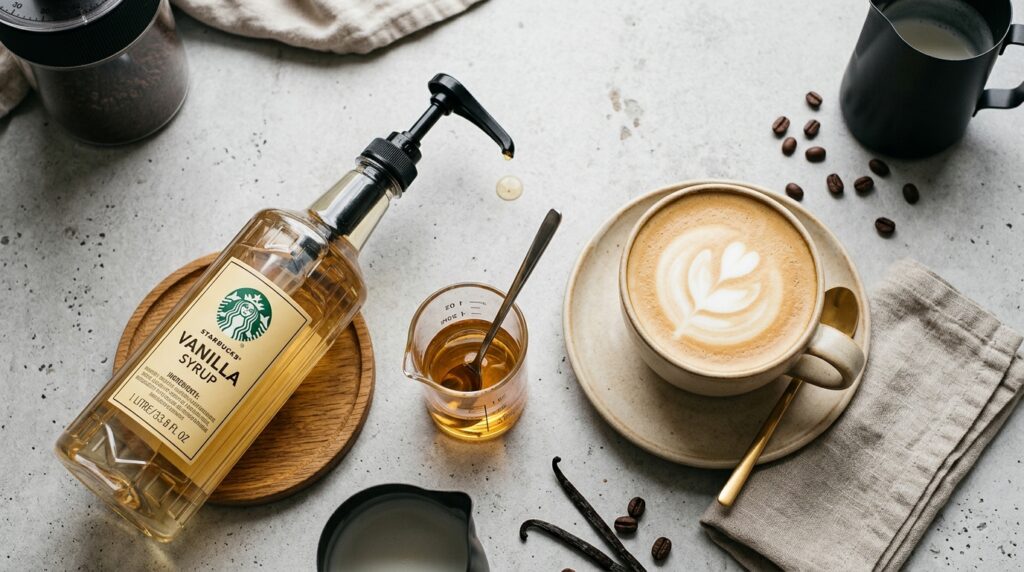
If you’re trying to figure out how many calories in vanilla syrup Starbucks adds to your order, the short answer is that it depends on how much syrup goes into your cup — and that amount changes with drink size, customization, and how many pumps you ask for. A standard nutrition serving of Starbucks vanilla syrup runs around 80 calories and 20 grams of sugar, but that’s not the same as “one pump,” which is a smaller amount used behind the counter.
This guide breaks down what’s actually known about vanilla syrup’s calorie and sugar content, why “per pump” numbers online don’t always agree, and how to estimate the syrup’s contribution to your next latte.
Quick Answer
- A standard 2-tablespoon nutrition serving of Starbucks vanilla syrup contains 80 calories and 20 grams of total sugar, based on USDA-listed branded food data for the retail syrup product.
- A single pump used by baristas is a smaller volume than a full 2-tablespoon serving, so the calories per pump are lower — Starbucks has not published an official “calories per pump” figure, so any per-pump number is a calculated estimate, not an exact company statistic.
- Sugar-free vanilla syrup contains close to 0 calories per serving, since it’s sweetened with sucralose instead of sugar.
- The best way to see the exact calories in your personal, customized drink is to build it in the Starbucks online nutrition calculator, since the company’s own tool reflects its current recipes.
How Many Calories Are in Starbucks Vanilla Syrup?
Vanilla syrup is a liquid sweetener made mostly of sugar, water, and natural flavoring. Because it’s nearly all sugar and water, almost every calorie in it comes from carbohydrate — there’s no fat or protein to speak of.
According to USDA FoodData Central’s branded food listing for Starbucks vanilla syrup, a 2-tablespoon (30g) serving contains 80 calories, all from 20 grams of carbohydrate, and all 20 of those grams are sugar (listed as added sugar). That 2-tablespoon amount is the standard nutrition-label serving size for the retail syrup bottle — it is not automatically the same as what goes into your drink at the counter.
| Amount | Estimated Calories | Estimated Sugar | Notes |
|---|---|---|---|
| 1 serving (2 tbsp / 30g) | 80 | 20g | Based on the retail syrup’s nutrition-label serving size |
| 1 pump (estimate) | ~13–20 | ~3–5g | Calculated estimate; pump volume varies by pump type (see below) |
| 2 pumps (estimate) | ~26–40 | ~6–10g | Scales roughly in proportion to pump volume |
| 3 pumps (estimate) | ~40–60 | ~10–15g | Typical default for a Tall hot espresso drink |
| 4 pumps (estimate) | ~53–80 | ~13–20g | Typical default for a Grande hot espresso drink |
| 5 pumps (estimate) | ~66–100 | ~16–25g | Typical default for a Venti hot espresso drink |
| 6 pumps (estimate) | ~80–120 | ~20–30g | Typical default for a Venti iced espresso drink |
These per-pump figures are calculated estimates, not numbers published directly by Starbucks. They’re derived by scaling the known 2-tablespoon nutrition-label serving down to a single pump’s volume, which — as the next section explains — isn’t a fixed, universally agreed-upon amount.
Starbucks Vanilla Syrup Calories Per Pump
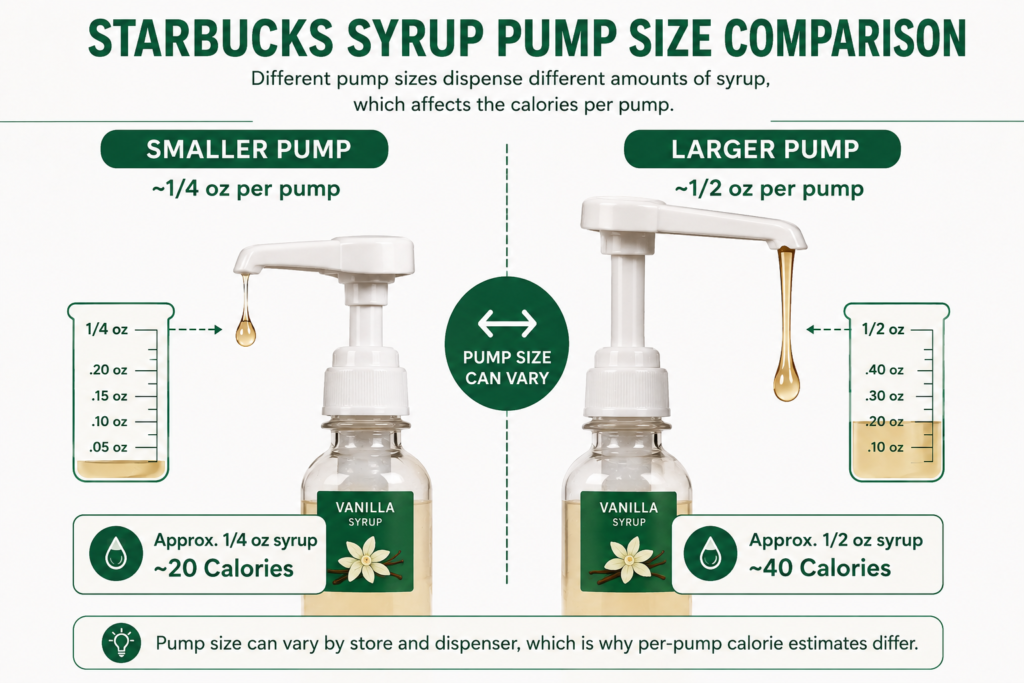
“How many calories are in one pump?” sounds like it should have a single clean answer, but it’s genuinely one of the murkier questions in Starbucks nutrition, for a few reasons.
Pump size isn’t standardized across every pump type. Multiple hospitality and food-industry sources describe two different pump mechanisms used behind Starbucks bars: a smaller pump commonly associated with hot bar syrup bottles, generally cited around 1/4 fluid ounce (about 7.5 ml) per pump, and a larger pump associated with cold bar bottles used for iced drinks and Frappuccinos, sometimes cited closer to 1/2 fluid ounce (about 15 ml) per pump. Because these figures come from industry commentary and equipment descriptions rather than an official nutrition disclosure, they should be treated as approximate rather than exact.
The nutrition-label serving size is not “one pump.” The 80-calorie, 20-gram-sugar figure discussed above is based on a 2-tablespoon (1 fl oz) serving of syrup — roughly two to four times the size of a single pump, depending on which pump size is used. That’s why dividing 80 calories evenly by “4 pumps per serving” gives a reasonable but still approximate per-pump estimate, not an official one.
Preparation and drink type matter. Hot and iced versions of the same drink don’t always use identical pump counts or the exact same syrup bottle setup, and Starbucks can adjust recipes and default pump counts over time.
Online sources disagree because they’re working from different assumptions. Some calorie calculators assume 1 pump equals 1 teaspoon, others assume 1/4 ounce, and others use 1/2 ounce. None of these assumptions have been confirmed as Starbucks’ single official pump measurement, which is exactly why the numbers you’ll find across different websites don’t match.
Given that uncertainty, the most reliable move is to treat any “calories per pump” figure — including the ranges in this article — as a helpful estimate for planning purposes, and to check your actual customized drink in the Starbucks app, which reflects the company’s current recipe data rather than a third-party assumption.
Starbucks Vanilla Syrup Nutrition Facts
Based on the USDA branded food listing for Starbucks vanilla syrup, here’s the nutrition breakdown per 2-tablespoon (30g) serving:
| Nutrient | Amount per 2 tbsp (30g) serving |
|---|---|
| Calories | 80 |
| Total Fat | 0g |
| Total Carbohydrate | 20g |
| Dietary Fiber | Not listed |
| Total Sugars | 20g |
| Added Sugars | 20g |
| Protein | 0g |
| Sodium | 0mg |
| Potassium | ~10mg |
| Ingredients | Sugar, water, natural flavor, potassium sorbate (preservative), citric acid |
Because the syrup contains no fat or protein, essentially every calorie comes from sugar. This is standard for flavored coffeehouse syrups generally, not something unique to Starbucks.
How Many Calories Are in 1, 2, 3, 4, 5 and 6 Pumps of Starbucks Vanilla Syrup?
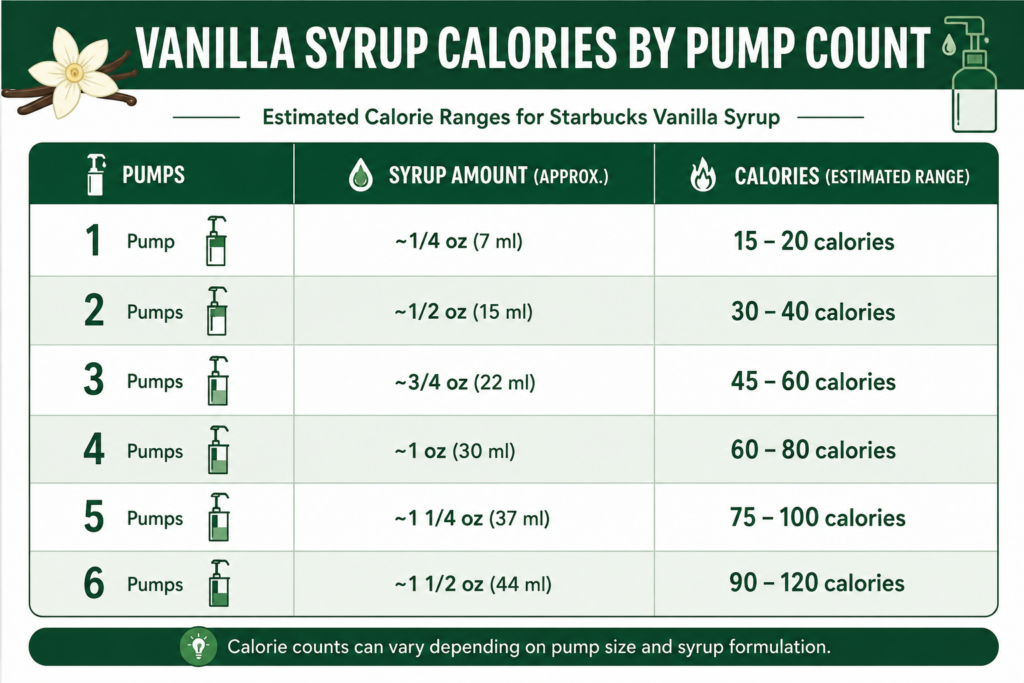
To make the syrup’s contribution easier to picture, here’s the math behind the estimates, using two common pump-size assumptions found across food-industry sources: a smaller ~1/4 oz pump and a larger ~1/2 oz pump. (Since 2 tablespoons equals 1 fluid ounce, a 1/4 oz pump is roughly one-quarter of the labeled serving, and a 1/2 oz pump is roughly half of it.)
| Pumps | Calories (¼ oz pump estimate) | Calories (½ oz pump estimate) | Sugar (¼ oz pump estimate) | Sugar (½ oz pump estimate) |
|---|---|---|---|---|
| 1 | ~20 | ~40 | ~5g | ~10g |
| 2 | ~40 | ~80 | ~10g | ~20g |
| 3 | ~60 | ~120 | ~15g | ~30g |
| 4 | ~80 | ~160 | ~20g | ~40g |
| 5 | ~100 | ~200 | ~25g | ~50g |
| 6 | ~120 | ~240 | ~30g | ~60g |
Two important caveats: first, real-world Starbucks drinks with 4, 5, or 6 pumps don’t necessarily add up to the higher end of this range, since actual customized drink nutrition published by Starbucks for specific beverages doesn’t always scale in perfectly linear fashion. Second, this table is meant to show a reasonable range for planning purposes — not a guaranteed number for any specific cup. If you want an exact figure for a specific size and pump count, the Starbucks app’s nutrition calculator for your exact customized drink is the most current source.
How Much Sugar Is in Starbucks Vanilla Syrup?
Nearly all of the syrup’s calories come from sugar. The labeled 2-tablespoon serving contains 20 grams of total sugar, all categorized as added sugar, with no fiber to offset it.
A few things to keep in mind about sugar and vanilla syrup specifically:
- Sugar scales with pump count. More pumps mean proportionally more sugar, following the same estimate ranges shown above.
- Total drink sugar is not the same as syrup sugar. Milk contributes natural sugar (lactose) on its own, even before any syrup is added. A plain latte made with dairy milk already has sugar in it from the milk.
- Other add-ins matter too. Whipped cream, sweet cream, flavored sauces (like mocha or caramel drizzle), and certain cold foams can add their own sugar on top of whatever the syrup contributes.
- Sugar-free vanilla syrup changes this picture significantly — more on that next.
Regular Vanilla Syrup vs. Sugar-Free Vanilla Syrup at Starbucks
Starbucks offers a sugar-free vanilla syrup option sweetened with sucralose instead of sugar. According to USDA branded food data for the sugar-free version, a 2-tablespoon (30g) serving contains close to 0 calories, 0g of fat, 0g of protein, and only about 1 gram of carbohydrate, with no significant sugar.
| Feature | Regular Vanilla Syrup | Sugar-Free Vanilla Syrup |
|---|---|---|
| Calories (2 tbsp serving) | 80 | ~0 |
| Sugar (2 tbsp serving) | 20g | ~0g |
| Carbohydrates (2 tbsp serving) | 20g | ~1g |
| Sweetened with | Sugar | Sucralose |
| Flavor profile | Classic, rounder sweetness | Similar vanilla flavor, slightly different sweetness character to some palates |
| Who may prefer it | Those not limiting sugar intake | Those watching sugar or carbohydrate intake |
| Important limitation | Adds meaningful calories/sugar as pump count increases | Does not make the entire drink “sugar-free” — milk and other add-ins still contribute calories, carbs, and sometimes sugar |
It’s worth being clear here: choosing sugar-free vanilla syrup lowers the syrup’s own contribution close to zero, but it doesn’t automatically make the whole beverage low-calorie or “healthy.” A large drink with whole milk, whipped cream, or extra add-ins can still carry a substantial calorie and fat count even with sugar-free syrup.
How Many Calories Does Vanilla Syrup Add to a Starbucks Coffee?
The final calorie count of any vanilla drink depends on several ingredients working together, not just the syrup:
- Coffee or espresso base — plain brewed coffee and straight espresso shots are very low in calories on their own.
- Milk — the type of milk (whole, 2%, nonfat, oat, almond, etc.) and how much is used can shift the calorie count by dozens to over a hundred calories, depending on size.
- Syrup — contributes calories primarily through sugar, scaling with pump count as shown earlier.
- Sauces — mocha, caramel, or other flavored sauces are typically higher in calories per pump than syrups because they often include fat as well as sugar.
- Cold foam — adds calories primarily from fat and a small amount of sugar, depending on the type.
- Whipped cream — a notable source of added fat and calories when included.
- Toppings — drizzles, sprinkles, and similar finishing touches add small but real amounts of extra sugar or fat.
In practice, this means two “vanilla” drinks of the same size can have very different calorie totals depending on milk choice, pump count, and whether whipped cream or other extras are included.
Calories in a Starbucks Vanilla Latte
A Vanilla Latte blends espresso, steamed milk, and vanilla syrup, so its total calorie count reflects contributions from all three:
- Espresso contributes minimal calories on its own.
- Milk is typically the single largest calorie source in a latte, especially with whole milk.
- Vanilla syrup adds calories mainly through sugar, scaling with the default pump count for the size ordered.
Because exact published nutrition can shift with recipe updates, milk substitutions, and size, this article won’t state a single “current” number as fixed. What’s consistent is the pattern: larger sizes, richer milk, and more syrup pumps all push the total higher, while smaller sizes, lighter milk, and fewer pumps bring it down. For the most accurate, up-to-date figure for a Grande, Tall, or Venti Vanilla Latte with your preferred milk, check the Starbucks app or Starbucks.com nutrition calculator, which reflects the company’s current recipe data.
Calories in a Starbucks Iced Vanilla Latte
The iced version follows the same basic formula — espresso, milk, and vanilla syrup — but the calorie total can differ from the hot version because of ice volume, cup size conventions for iced drinks, and sometimes different default pump counts for iced preparation.
As with the hot latte, milk choice has a major effect: switching from whole milk to nonfat or a plant-based milk noticeably changes the total, independent of how much vanilla syrup is used.
If you’re specifically checking the calories in a Starbucks iced latte more broadly (without the vanilla flavoring), see our guide to Starbucks Iced Caffè Latte calories for a closer look at how milk and size alone affect the base drink before any syrup is added.
How to Order a Lower-Calorie Starbucks Vanilla Drink
If you enjoy the vanilla flavor but want to manage calories or sugar, a few practical adjustments can help:
- Ask for fewer syrup pumps. Requesting “half sweet” or a specific lower pump count (like 2 pumps instead of the default 4 in a Grande) directly reduces the syrup’s calorie and sugar contribution.
- Try sugar-free vanilla syrup if you want the vanilla flavor with minimal calories from the syrup itself.
- Choose a smaller size, since pump counts and milk volume typically scale up with drink size.
- Consider your milk choice. Nonfat milk or unsweetened plant-based milk can meaningfully lower the total compared to whole milk.
- Skip whipped cream if you’re trying to reduce added fat and calories.
- Watch cold foam, sauces, and drizzle toppings, since these can add calories that aren’t obvious from the drink name alone.
- Check the Starbucks app before ordering a heavily customized drink, since it will show nutrition for your exact combination of size, milk, and pump count.
None of these swaps are about labeling a drink “good” or “bad” — they’re simply practical ways to adjust the calorie and sugar contribution to match what you’re looking for.
Does Starbucks Vanilla Syrup Have Fat or Protein?
Based on the USDA branded food listing, regular vanilla syrup contains 0 grams of fat and 0 grams of protein per serving. Its calories come entirely from carbohydrate, specifically sugar. Sugar-free vanilla syrup is similar in this respect — also essentially 0g fat and 0g protein — with its very low calorie count coming from a small amount of carbohydrate rather than sugar.
Is Starbucks Vanilla Syrup Keto-Friendly?
This is a case where the honest answer is “it depends, and you should verify for your specific needs.”
Regular vanilla syrup contains 20 grams of sugar and carbohydrate per labeled serving, which is significant for most ketogenic diet plans that limit daily carbohydrate intake to a narrow range. Adding even a modest number of pumps of regular vanilla syrup can use up a meaningful share of a strict keto carb budget.
Sugar-free vanilla syrup contains far less carbohydrate — close to 0g of sugar and only about 1g of carbohydrate per labeled serving — which is generally more compatible with lower-carb eating patterns. That said, this article isn’t offering medical or dietary advice, and anyone following a strict ketogenic or medically supervised diet should review current ingredient and nutrition information directly and consider checking with a healthcare provider about how it fits their specific plan.
Is Starbucks Vanilla Syrup Vegan?
Based on its listed ingredients — sugar, water, natural flavor, potassium sorbate, and citric acid — regular vanilla syrup does not include obvious animal-derived ingredients. However, ingredient formulations, sourcing, and regional product variations can change over time, and “natural flavor” ingredients aren’t always fully transparent about their origin. If strict vegan certification matters to you, it’s worth verifying current ingredient details directly through Starbucks’ official ingredient and allergen resources rather than relying solely on this summary.
Does Vanilla Syrup Add More Calories Than Milk?
In most standard lattes, milk tends to contribute more total calories than the syrup does, particularly with whole milk in larger sizes, since milk brings both fat and natural sugar (lactose) to the mix. Vanilla syrup, by contrast, contributes calories almost entirely through added sugar and scales with pump count rather than drink volume.
That said, the exact comparison depends heavily on your specific order. A drink with extra syrup pumps and nonfat milk could have proportionally more calories coming from syrup than from milk, while a drink with the default pump count and whole milk will likely see milk as the bigger calorie contributor. Espresso itself adds only a small amount either way.
Starbucks Vanilla Syrup Ingredients
According to USDA branded food data reflecting Starbucks’ own product labeling, regular vanilla syrup contains: sugar, water, natural flavor, potassium sorbate (as a preservative), and citric acid.
Sugar-free vanilla syrup contains a different formulation built around a sugar substitute, generally including water, natural flavor, and sucralose along with thickening and stabilizing ingredients rather than sugar.
Because ingredient lists can be updated by manufacturers over time, and formulations occasionally vary by region, readers with allergies or strict dietary requirements should check Starbucks’ current official ingredient and allergen information before ordering.
Why Your Starbucks Vanilla Drink May Have More Calories Than Expected
A few common customization choices can push a “vanilla” drink’s calorie count higher than someone might assume from the name alone:
- Extra syrup pumps beyond the default for your size
- Whole milk instead of a lighter milk option
- Sweet cream added on top of an already-sweetened drink
- Cold foam, which adds calories from fat even without added sugar
- Whipped cream, a concentrated source of fat and calories
- Additional sauces or drizzles layered on top of the syrup
- Larger sizes, which typically come with more milk and more syrup pumps by default
- Stacking multiple customizations at once, which compounds all of the above
None of these are inherently a problem — they’re simply worth knowing about if you’re trying to estimate a drink’s calorie count before ordering.
How to Calculate Calories in a Customized Starbucks Drink
If you want to build a rough estimate of your own order, this step-by-step approach can help:
- Start with the base drink’s standard nutrition for your chosen size (for example, a standard Grande Latte before any flavoring).
- Check that drink’s standard published nutrition through Starbucks’ official nutrition information.
- Identify how many syrup pumps you’re planning to order, keeping in mind the default pump count typically scales with size.
- Add the estimated syrup contribution using the ranges discussed earlier in this guide, remembering they are estimates rather than official per-pump figures.
- Account for any milk changes, since switching milk type shifts calories, fat, and sugar independently of the syrup.
- Add any toppings or sauces, such as whipped cream, cold foam, or drizzle, using their individual nutrition contributions.
- Cross-check the final total using Starbucks’ current nutrition calculator or app, which will reflect the company’s actual recipe data for your exact customization far more precisely than manual addition can.
This method is useful for getting a reasonable ballpark figure before you order, but the Starbucks app remains the most accurate source for your specific cup, since it’s built directly from the company’s current recipe and portion data.
Frequently Asked Questions
How many calories are in Starbucks vanilla syrup? A standard 2-tablespoon nutrition-label serving of the retail syrup contains 80 calories, based on USDA branded food data. A single pump used behind the counter is a smaller amount than this full serving, so its calorie contribution is proportionally lower.
How many calories are in one pump of Starbucks vanilla syrup? There’s no official Starbucks figure for this specific measurement. Based on common pump-size estimates ranging from about 1/4 to 1/2 fluid ounce, one pump likely contributes somewhere in the range of roughly 20 to 40 calories.
How many calories are in 2 pumps of Starbucks vanilla syrup? Using the same estimate ranges, 2 pumps likely add somewhere around 40 to 80 calories, though this depends on the actual pump volume used.
How many calories are in 4 pumps of Starbucks vanilla syrup? Four pumps — a common default for a Grande hot espresso drink — likely add somewhere in the range of about 80 to 160 calories, based on the same estimate ranges.
How much sugar is in Starbucks vanilla syrup? A 2-tablespoon labeled serving contains 20 grams of sugar, all of it categorized as added sugar, according to USDA branded food data.
Is Starbucks vanilla syrup sugar-free? Regular vanilla syrup is not sugar-free — it’s sweetened primarily with sugar. Starbucks also offers a separate sugar-free vanilla syrup option sweetened with sucralose instead.
How many calories does vanilla syrup add to coffee? It depends on how many pumps are used, since the syrup’s calories scale with pump count rather than being a fixed amount per drink.
Does sugar-free vanilla syrup have calories? Sugar-free vanilla syrup is close to calorie-free, with USDA branded food data showing roughly 0 calories per labeled serving.
How many calories are in a Starbucks vanilla latte? This varies by size, milk choice, and pump count, so there isn’t one fixed number. Checking the Starbucks app for your exact size and customization gives the most accurate current figure.
How many calories are in a Starbucks iced vanilla latte? Like the hot version, this depends on size, milk, and syrup amount. For a closer look at how milk and size affect a plain iced latte, see our Starbucks Iced Caffè Latte calories guide.
Can I ask Starbucks for fewer pumps of vanilla syrup? Yes. Baristas can adjust the number of syrup pumps on request, which directly changes the calorie and sugar contribution from the syrup.
Does changing the milk affect the calories in a vanilla latte? Yes, significantly. Milk is often the largest single calorie contributor in a latte, so switching between whole milk, lower-fat milk, or a plant-based option can shift the total noticeably, independent of the syrup itself.
Final Takeaway
Vanilla syrup adds calories and sugar to a Starbucks drink mainly through its sugar content, and the exact amount depends on how many pumps are used and how the drink is otherwise customized. A labeled 2-tablespoon serving of regular syrup comes in at 80 calories and 20 grams of sugar, but a single pump is a smaller, less precisely documented amount — which is why per-pump figures online, including the estimates in this guide, should be treated as reasonable approximations rather than official numbers.
Ordering fewer pumps, choosing sugar-free vanilla syrup, or adjusting your milk can all meaningfully change your drink’s calorie and sugar total. For the most accurate figure for your specific cup, the Starbucks app’s nutrition tool remains the best source, since it reflects the company’s current recipe data rather than a third-party estimate.
Sources
- USDA FoodData Central — Branded Food listing for Starbucks Coffee Vanilla Syrup (nutrition and ingredient data)
- USDA FoodData Central — Branded Food listing for Starbucks Coffee Sugar-Free Vanilla Syrup (nutrition and ingredient data)
- Starbucks Coffee Company official menu and nutrition pages (starbucks.com/menu) — for current beverage-level nutrition information
- Starbucks Coffee Company customization and allergen information — for confirmation that pump counts and syrup choices can be adjusted by request
Readers seeking the most current, official nutrition figures for a specific customized drink should always cross-check using the Starbucks app or Starbucks.com nutrition calculator, since recipes and default pump counts can be updated over time.