Iced Caffe Latte Starbucks Calories: A Refreshing, Low-Calorie Way to Enjoy Your Coffee
Last Updated: September, 2026 · By BrewTrack Utility Editorial Team
If you’re searching for iced caffe latte starbucks calories before you place your order, you want a number fast — not a long backstory about espresso history. Below you’ll find the exact calorie range by size, how milk choice and add-ins shift that number, and the full nutrition breakdown so you can order with confidence.
Quick Answer: How Many Calories Are in a Starbucks Iced Caffè Latte?
A Starbucks Iced Caffè Latte made with 2% milk runs from 100 calories in a Tall to about 180 calories in a Venti. That’s the standard build most people get when they order at the counter or through the app without any customization.
| Size | Fluid Ounces | Calories (2% Milk) | Espresso Shots |
|---|---|---|---|
| Tall | 12 fl oz | 100 | 1 |
| Grande | 16 fl oz | 130 | 2 |
| Venti | 24 fl oz | 180 | 3 |
Those numbers reflect the default recipe: espresso, 2% milk, and ice. Swap the milk, add a syrup, or ask for extra shots and the total shifts — sometimes by a lot. The rest of this guide breaks down exactly how much each change matters, using the most reliable nutrition data available for Starbucks’ iced espresso menu.
Starbucks Iced Caffe Latte Calories by Size
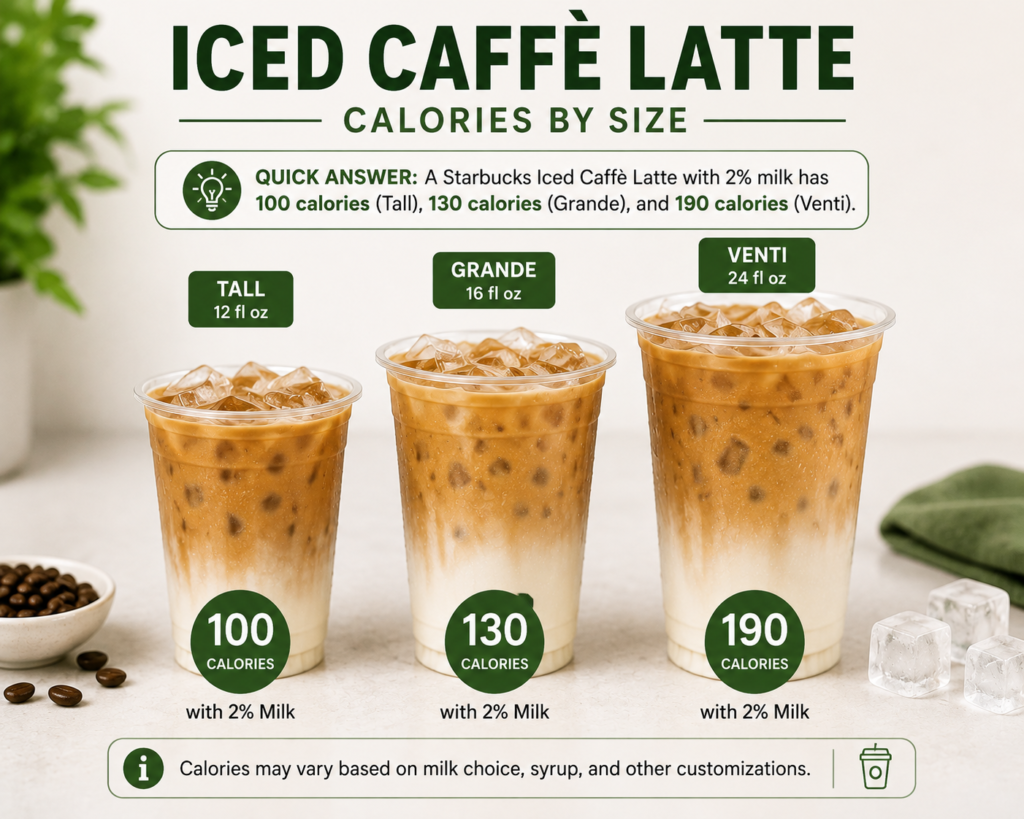
Size is the single biggest factor in the calorie count of an iced caffè latte, mostly because a bigger cup means more milk. Interestingly, it also means more espresso — Starbucks adds an extra shot to iced venti drinks specifically because the added ice would otherwise water down the flavor as it melts.
| Size | Fl Oz | Calories | Caffeine (approx.) | Sugar (approx.) | Protein (approx.) |
|---|---|---|---|---|---|
| Tall | 12 | 100 | 75 mg | 9 g | 6 g |
| Grande | 16 | 130 | 150 mg | 11 g | 8 g |
| Venti | 24 | 180 | 225 mg | 13–14 g | 12 g |
These figures are for the standard 2% milk build with no syrup. Sugar and protein figures for Venti are approximate because not every tracking source publishes a full breakdown for that size, though the calorie counts are consistent across multiple independent nutrition databases. If you’re building a custom order and want exact numbers for your combination, a Starbucks calorie calculator can adjust the totals as you add or remove ingredients.
Starbucks Iced Caffe Latte Calories by Milk Type
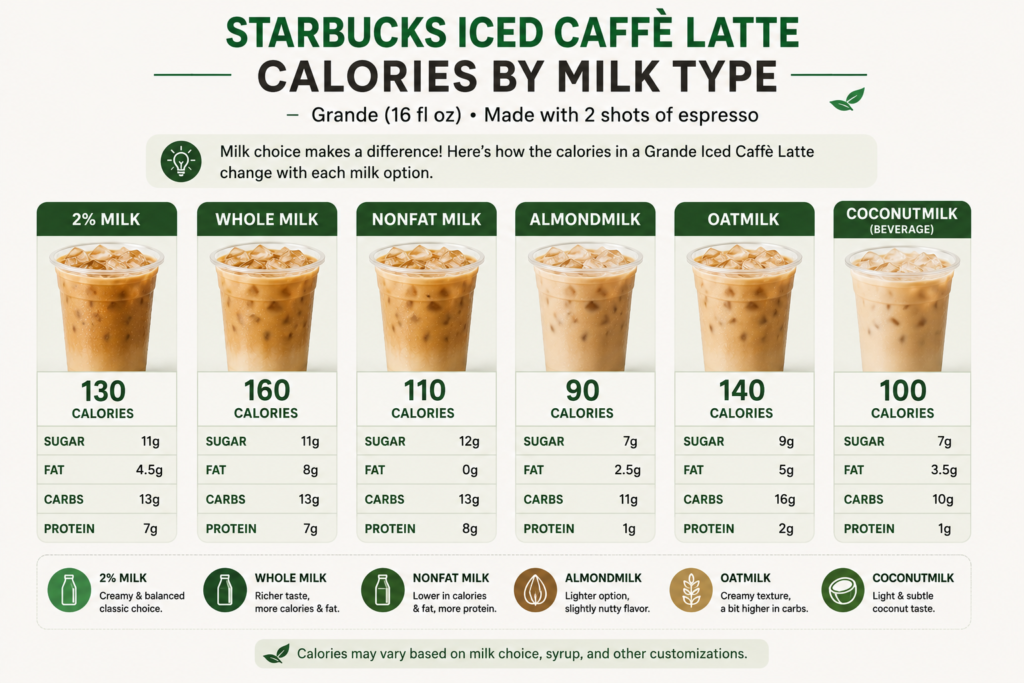
Milk is where most of the calories in a latte actually come from. The espresso itself barely registers — a single shot has around 5 calories, so two or three shots add almost nothing to the total. Everything else in the swing between a 70-calorie latte and a 210-calorie latte comes down to which milk hits the cup.
Here’s roughly how a Grande (16 oz) Iced Caffè Latte compares across common milk options:
| Milk Option | Approx. Calories (Grande) | Notes |
|---|---|---|
| Almondmilk | ~70 | Lowest-calorie option; also lowest in protein |
| Coconutmilk | ~90 | Naturally sweet, higher saturated fat |
| Nonfat milk | ~100–110 | Keeps protein, cuts fat to near zero |
| 2% milk (standard) | 130 | Default recipe unless you specify otherwise |
| Soymilk | ~130 | Comparable calories to 2%, more protein |
| Whole milk | 150 | Richer texture, more saturated fat |
| Oatmilk | ~150–170 | Higher fat than dairy milk; naturally a bit sweet |
A few things worth understanding about why these numbers move:
Fat content drives most of the difference. Whole milk and oatmilk both carry more fat per ounce than nonfat or almondmilk, so they push calories up even though the espresso and ice stay identical.
Almondmilk is thin nutritionally as well as calorically. It saves the most calories, but it also delivers less protein than dairy or soy — worth knowing if you’re using your latte as part of a higher-protein breakfast.
Oatmilk isn’t automatically the “healthy” choice. It has a reputation as a lighter plant-based option, but Starbucks’ oatmilk blend is relatively high in fat, which means an oatmilk latte can land closer to (or above) a whole milk latte in total calories, depending on size.
Since November 2024, Starbucks stopped charging extra for non-dairy milk at U.S. and Canadian company-owned stores, so switching milk is now a purely nutritional decision rather than a cost one.
Grande Iced Caffe Latte Starbucks Calories
The Grande is the most frequently ordered size, so it’s worth a closer look on its own.
A standard Grande Iced Caffè Latte with 2% milk contains:
- Calories: 130
- Total fat: 4.5 g (2.5 g saturated)
- Carbohydrates: 13 g
- Sugar: 11 g (naturally occurring from milk — no added sugar in the plain recipe)
- Protein: 8 g
- Caffeine: 150 mg
- Cholesterol: 20 mg
- Sodium: 115 mg
These figures describe the drink exactly as it comes off the standard recipe card — milk, two shots of espresso, and ice. The moment you add flavored syrup, whipped topping, or swap the milk, these numbers change, sometimes significantly. A flavored Grande iced latte with a few pumps of syrup can add anywhere from 40 to 100 extra calories on top of the base 130, depending on the syrup and how many pumps go in.
Tall vs Grande vs Venti Iced Caffe Latte
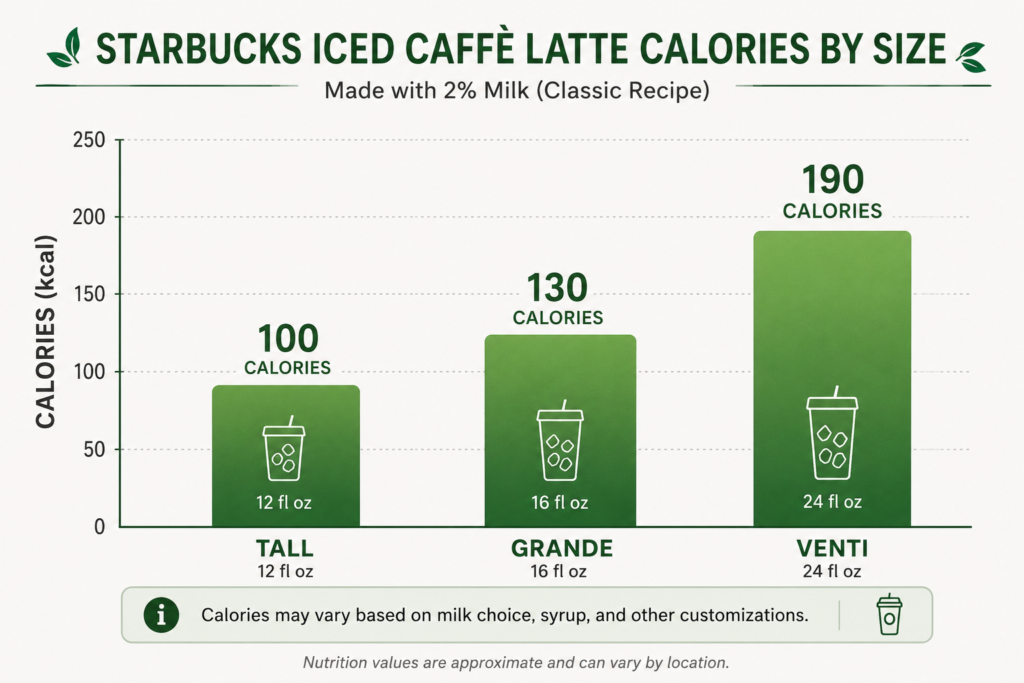
| Feature | Tall (12 oz) | Grande (16 oz) | Venti (24 oz) |
|---|---|---|---|
| Calories | 100 | 130 | 180 |
| Espresso shots | 1 | 2 | 3 |
| Caffeine | 75 mg | 150 mg | 225 mg |
| Calories per oz | ~8.3 | ~8.1 | ~7.5 |
Notice that calories don’t scale in a straight line with size. A Venti is exactly double the volume of a Tall, but it doesn’t have double the calories — it has 80% more. That’s because the milk-to-ice ratio changes across sizes, and the extra espresso shot in the Venti adds volume and caffeine without adding many calories. In practical terms, ordering a larger size doesn’t cost you as much calorically as it might seem, though obviously the total is still higher than sticking with a Tall.
Starbucks Iced Latte Nutrition Facts
Beyond calories, here’s the fuller nutrition profile for the standard 2% milk recipe. These numbers reflect the plain drink with no flavoring:
| Nutrient | Tall | Grande | Venti |
|---|---|---|---|
| Calories | 100 | 130 | 180 |
| Total Fat | 3.5 g | 4.5 g | ~7 g |
| Saturated Fat | 2 g | 2.5 g | ~4 g |
| Carbohydrates | 10 g | 13 g | ~18 g |
| Sugar | 9 g | 11 g | ~14 g |
| Protein | 6 g | 8 g | ~12 g |
| Caffeine | 75 mg | 150 mg | 225 mg |
The sugar in a plain iced caffè latte is entirely lactose — the natural sugar found in milk. There’s no added sugar in the standard recipe, which is one reason this drink tends to sit lower in sugar than flavored espresso drinks or Frappuccinos.
How Much Sugar Is in a Starbucks Iced Caffè Latte?
This is one of the most misunderstood parts of ordering a latte. A plain Iced Caffè Latte has no added sugar at all — every gram of sugar you see on the nutrition label comes from lactose, the sugar naturally present in milk. A Grande has about 11 grams, all of it dairy-derived.
That changes the moment you add a flavored syrup. Vanilla, caramel, and mocha syrups all contain added sugar, and the total depends on how many pumps go into the drink — Starbucks typically uses more pumps in larger sizes by default (for example, a Grande might get four pumps where a Tall gets three). A few pumps of syrup can easily add 15–25 grams of sugar on top of the milk sugar already in the drink.
So there are really two different drinks hiding under one name: a plain iced caffè latte, which is a relatively low-sugar coffee drink, and a flavored iced latte, which behaves nutritionally more like a dessert beverage. If sugar is a concern, asking for sugar-free syrup or skipping syrup altogether keeps the drink close to its base nutrition numbers.
How Much Caffeine Is in a Starbucks Iced Caffè Latte?
Caffeine scales directly with the number of espresso shots, and each Starbucks espresso shot contains about 75 mg of caffeine.
| Size | Shots | Caffeine |
|---|---|---|
| Tall | 1 | 75 mg |
| Grande | 2 | 150 mg |
| Venti | 3 | 225 mg |
Notice the Venti gets three shots instead of the two you might expect from simply doubling the Tall. That’s a deliberate recipe choice — the extra shot compensates for the larger volume of ice in a Venti cup, keeping the coffee-to-milk ratio from tasting watered down as the ice melts.
Adding an extra shot on request increases caffeine by roughly 75 mg per shot and adds only a few calories, since espresso itself is nearly calorie-free. So if you want more caffeine without dramatically changing the calorie count, an extra shot is a more efficient move than upsizing the whole drink.
What Is in a Starbucks Iced Caffè Latte?
At its core, the Iced Caffè Latte is a simple three-ingredient drink:
- Espresso — one to three shots depending on size
- Milk — 2% by default, with dairy and non-dairy alternatives available
- Ice — fills the remaining volume in the cup
That’s the entire base recipe. Everything else — flavored syrups, sauces, sweeteners, cold foam, whipped cream — is an optional add-on, and each one changes the nutrition profile differently:
- Syrups (vanilla, caramel, hazelnut, etc.) mainly add sugar and carbohydrates
- Sauces (mocha, caramel drizzle) tend to add sugar plus a small amount of fat
- Cold foam adds calories and fat from cream, with minimal sugar
- Whipped cream adds saturated fat and a modest amount of sugar
- Extra espresso shots add caffeine with almost no calorie impact
Because the base drink is so simple, it’s also one of the more transparent things to customize — you’re really only adjusting two variables (milk and add-ins) rather than untangling a complex multi-ingredient recipe.
Is a Starbucks Iced Caffè Latte Healthy?
There’s no single answer here, because “healthy” depends on what you’re comparing it to and what your own goals are. What’s fair to say is that the plain Iced Caffè Latte is one of the more nutritionally straightforward drinks on the Starbucks menu. It has no added sugar, a moderate calorie count for a milk-based drink, and a meaningful amount of protein and calcium from the milk itself.
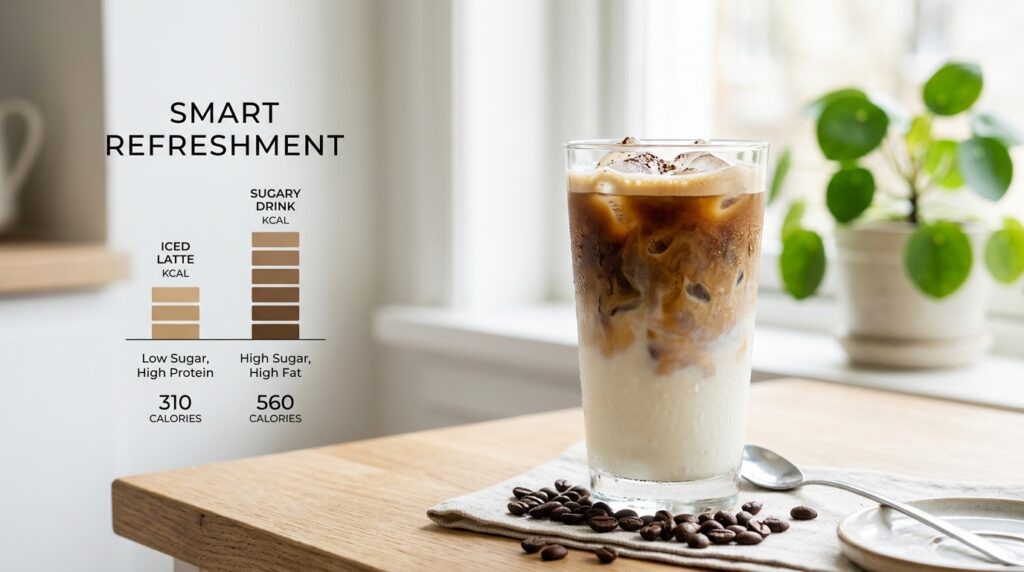
Compared to many flavored espresso drinks or Frappuccinos — which can run 300–500 calories with 40+ grams of added sugar — a plain iced latte is a lighter option. Compared to black coffee or an Americano, it’s higher in calories and sugar because of the milk.
Rather than labeling the drink as universally good or bad, it’s more useful to think about:
- Your calorie budget for the day — a 130-calorie Grande fits easily into most eating patterns
- Your sugar goals — the plain version is low in added sugar; flavored versions are not
- Your protein needs — the milk contributes meaningful protein, more so with nonfat or dairy milk than with almondmilk
- Your caffeine tolerance — especially relevant if you’re also drinking other caffeinated beverages that day
If you have specific dietary or medical concerns, checking with a doctor or registered dietitian about how this drink fits your individual needs is more useful than any general rule.
How to Order a Lower-Calorie Starbucks Iced Latte
If your goal is to trim calories without giving up the drink entirely, a few adjustments make a real difference:
- Choose a smaller size. Dropping from Venti to Grande alone saves around 50 calories.
- Switch to a lower-calorie milk. Nonfat or almondmilk both come in well under the standard 2% recipe.
- Skip or limit syrup. Asking for sugar-free syrup, or just one pump instead of the default, cuts a meaningful chunk of added sugar.
- Avoid calorie-dense toppings. Cold foam and whipped cream both add calories without adding much nutritional value.
- Ask for fewer pumps of sauce or drizzle. These are usually easy to reduce without asking for a full removal.
- Consider your espresso-to-milk ratio. Requesting “light ice” increases the amount of milk in the cup, which can raise calories slightly — “extra ice” does the opposite.
None of these changes guarantees an exact final number, since store-to-store measuring can vary slightly, but each one moves the total in a predictable direction.
Lowest-Calorie Ways to Customize an Iced Caffè Latte
| Customization | Why It Lowers Calories | Tradeoff |
|---|---|---|
| Almondmilk instead of whole milk | Almondmilk has less fat and fewer calories per ounce | Less protein, thinner texture |
| Nonfat milk instead of 2% | Removes most of the fat while keeping protein | Slightly less creamy mouthfeel |
| Sugar-free syrup | Removes added sugar and its calories | Different sweetness profile than regular syrup |
| Skip whipped cream / cold foam | Removes a concentrated source of fat and calories | Loses the topping’s texture and flavor |
| Smaller size | Less milk overall | Less caffeine and less volume |
| Light ice | More room for milk isn’t necessarily fewer calories — pairs best with a smaller size if cutting calories is the goal | Slightly more drink liquid |
Iced Caffè Latte vs Other Starbucks Cold Coffee Drinks
| Drink | Grande Calories (approx.) | Milk? | Sweetness | Caffeine |
|---|---|---|---|---|
| Iced Caffè Latte (plain) | 130 | Yes | Low (natural milk sugar only) | 150 mg |
| Iced Americano | 15 | No | None | 225 mg |
| Iced Flat White | 170 | Yes (less than latte, more concentrated) | Low | 195 mg |
| Cold Brew (plain) | 5 | No | None | 205 mg |
| Flavored Iced Latte (e.g., vanilla) | ~190–240 | Yes | High (added syrup) | 150 mg |
A few takeaways from this comparison:
The Iced Americano is the lowest-calorie option by a wide margin, since it’s just espresso and water — no milk at all. It also has more caffeine than a latte of the same size because it uses more concentrated espresso.
Cold Brew is nearly calorie-free on its own, but people often add milk or sweetener to it, which changes the picture significantly.
The Iced Flat White packs a similar amount of milk into a smaller, more concentrated drink, so it can actually land close to or above a latte in calories despite feeling like a “smaller” order.
Flavored lattes are a different category entirely — the added syrup is what pushes them well above the plain version.
If you’re comparing several options side by side while deciding what to order, a Starbucks Nutrition calculator can help you weigh calories against caffeine and sugar for your specific size and milk choice.
Does Adding Syrup Change Starbucks Iced Latte Calories?
Yes, and the effect is cumulative — each pump of flavored syrup adds both calories and sugar, and Starbucks’ default pump counts increase with drink size. A Tall typically gets fewer pumps by default than a Grande or Venti, so simply upsizing a flavored latte compounds two effects at once: more milk and more syrup.
The exact calorie contribution varies by syrup type and hasn’t been verified here with certainty for every flavor, so rather than quoting a specific number for each one, the more reliable approach is to ask for half the standard pumps, sugar-free syrup, or no syrup if you want to keep the drink closer to its plain nutrition profile. A Starbucks calorie calculator that lets you adjust pump count is the most accurate way to see the real difference for your specific order.
What Happens to Calories When You Add an Extra Espresso Shot?
Espresso is nearly calorie-free — a single shot contains only around 5 calories. So when you ask for an extra shot in your iced caffè latte:
- Caffeine increases by roughly 75 mg per added shot
- Calories increase by only a few — not enough to meaningfully change the total
- The overall calorie count is still driven almost entirely by the milk, not the coffee
This makes extra shots one of the most efficient customizations available if your goal is more caffeine without a real calorie tradeoff. It’s a very different decision than adding syrup, which affects both caffeine-adjacent alertness expectations and calories simultaneously — extra shots really only touch caffeine.
Is an Iced Caffè Latte Good for Weight-Conscious Orders?
This isn’t a question with a universal yes or no answer, since it depends on someone’s overall daily intake, activity level, and personal goals — factors this guide can’t know. What can help is comparing the drink on the metrics that actually matter for a weight-conscious order:
- Calories per size — 100 to 180 depending on size, before any add-ins
- Protein content — a Grande has 8 grams, which is more than most other Starbucks cold drinks besides protein-fortified options
- Sugar content — low in the plain version, high in flavored versions
- Portion control — sticking to Tall or Grande naturally limits the total
Comparing these numbers against your own daily targets, rather than relying on a blanket label like “diet-friendly,” gives a clearer picture of whether this drink fits your particular routine.
Starbucks Iced Caffe Latte Ingredients and Allergens
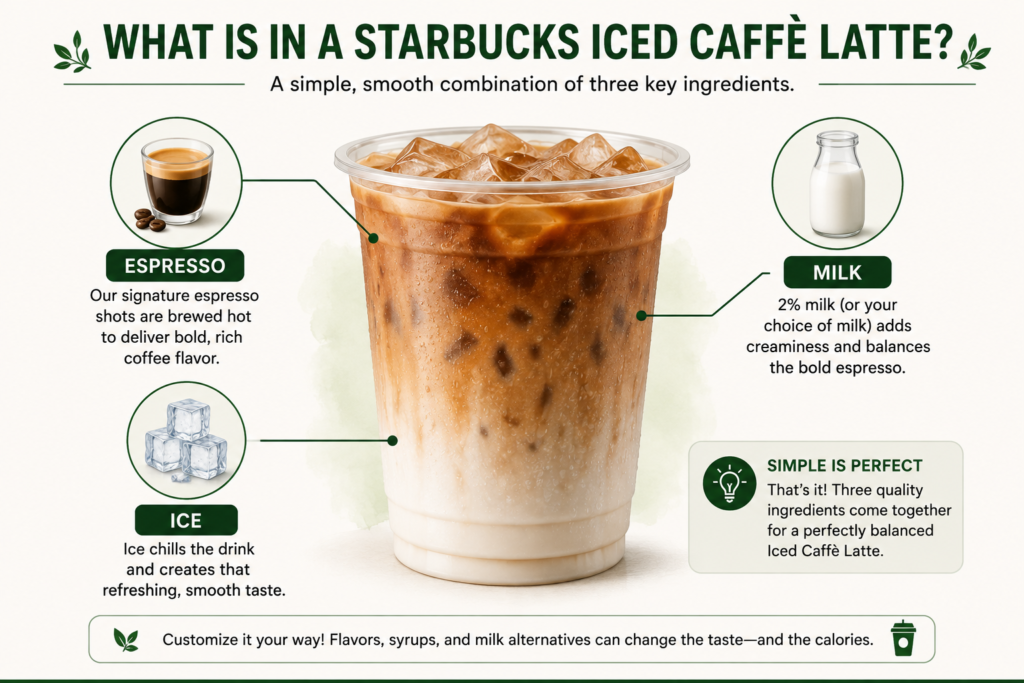
The standard recipe uses dairy milk (2% by default) along with brewed espresso and ice. For people with dairy sensitivities or preferences, Starbucks offers several substitutions, including almondmilk, oatmilk, soymilk, and coconutmilk.
A few allergen notes worth knowing:
- Dairy is present in the default recipe unless a non-dairy milk is requested
- Tree nuts are present if almondmilk is chosen
- Soy is present if soymilk is chosen
- Non-dairy milks are prepared using shared equipment in most stores, so Starbucks does not guarantee an allergen-free environment even when a substitution is made
If you have a serious allergy, it’s worth checking directly with store staff about preparation practices rather than relying solely on the ingredient list, since cross-contact can occur even when a specific allergen isn’t intentionally added.
How to Order an Iced Caffè Latte on the Starbucks App
The general customization flow for building this drink typically follows the same pattern across most ordering methods:
- Select the drink — search or browse to “Iced Caffè Latte”
- Choose your size — Tall, Grande, or Venti
- Pick your milk — 2%, whole, nonfat, oat, almond, soy, or coconut
- Adjust espresso — add or remove shots, or choose decaf
- Add syrup or sauce if desired — and adjust the pump count
- Set your ice level — light, regular, or extra
- Add toppings — cold foam, whipped cream, or similar options if available
- Review the order — many ordering tools display an estimated nutrition summary before checkout
Exact menu layouts and available customizations can vary by app version and region, so the steps above describe the general process rather than a guaranteed current screen-by-screen walkthrough.
Frequently Asked Questions
How many calories are in a Starbucks Iced Caffè Latte?
A plain Iced Caffè Latte with 2% milk has 100 calories in a Tall, 130 in a Grande, and about 180 in a Venti. These numbers change if you switch the milk or add syrup.
How many calories are in a Grande Iced Latte from Starbucks?
A Grande Iced Caffè Latte with standard 2% milk has 130 calories, 8 grams of protein, and 150 mg of caffeine.
Is a Starbucks Iced Caffè Latte low in calories?
Compared to flavored espresso drinks and Frappuccinos, yes — the plain version is one of the lower-calorie milk-based drinks on the menu. It’s higher in calories than black coffee or an Americano, since it contains milk.
How many calories does an Iced Latte have with almond milk?
Switching to almondmilk brings a Grande down to roughly 70 calories, making it the lowest-calorie milk option for this drink, though it also has less protein than dairy milk.
How many calories does an Iced Latte have with oat milk?
Oatmilk actually tends to add calories compared to the standard 2% recipe — a Grande with oatmilk lands somewhere around 150–170 calories, since Starbucks’ oatmilk blend is relatively high in fat.
Does a Starbucks Iced Latte have added sugar?
No, not in the plain version. All of the sugar in a plain iced caffè latte comes naturally from milk. Added sugar only enters the picture if you order a flavored syrup.
How much caffeine is in a Starbucks Iced Caffè Latte?
Caffeine depends on size: about 75 mg in a Tall, 150 mg in a Grande, and 225 mg in a Venti, since the Venti gets an extra espresso shot.
What is the lowest-calorie milk for a Starbucks iced latte?
Almondmilk is currently the lowest-calorie milk option for this drink, followed by coconutmilk and nonfat milk.
Can I make a Starbucks Iced Caffè Latte healthier?
You can lower the calorie and sugar content by choosing a smaller size, switching to a lighter milk, skipping or reducing syrup, and avoiding toppings like whipped cream. Whether that makes the drink “healthier” depends on your individual nutrition goals.
Does adding vanilla syrup increase the calories?
Yes. Vanilla syrup adds both calories and sugar, and the amount depends on how many pumps are used. Asking for fewer pumps or sugar-free syrup keeps the total closer to the plain drink’s nutrition profile.
Is the Iced Caffè Latte different from a regular Iced Latte?
At Starbucks, “Iced Caffè Latte” and “Iced Latte” typically refer to the same drink — espresso, milk, and ice. The Italian-style “Caffè Latte” naming is simply the full menu name for the plain version.
Why does a Venti have more espresso shots than a Tall or Grande combined ratio would suggest?
Because Starbucks adds a third shot specifically for iced Venti drinks to offset the extra ice, keeping the coffee flavor from getting diluted as it melts — a Tall and Grande hot latte follow a different shot pattern than their iced Venti counterpart.