Starbucks Iced Latte Nutrition: Calories, Sugar, Protein, Fat & Caffeine
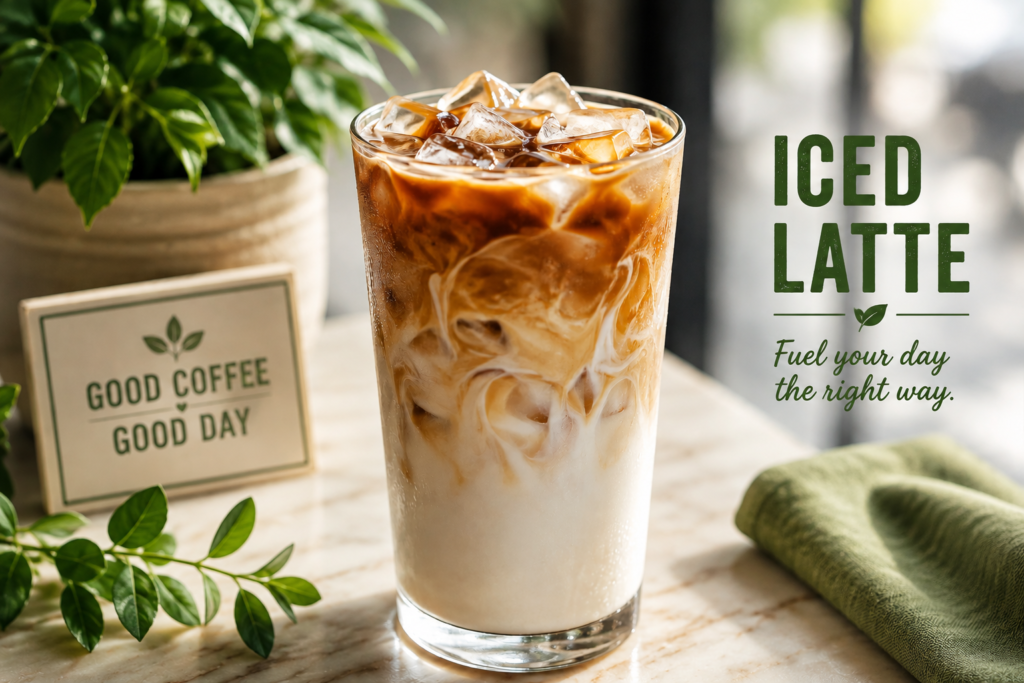
If you’ve ever ordered an iced latte and wondered what’s actually in it beyond “espresso and milk,” you’re asking a fair question. Starbucks’ iced latte nutrition profile is deceptively simple on paper — a Grande has 130 calories, 11 grams of sugar, and 8 grams of protein — but that single number changes considerably depending on your size, your milk, and anything you add to it.
This guide covers the full nutritional picture of a Starbucks Iced Caffè Latte: calories, sugar, protein, fat, carbohydrates, and caffeine, across all three iced sizes and the most common milk swaps. If you specifically want a deeper breakdown of calories by size and customization, our Starbucks iced latte calories guide covers that in more detail — this article is built to give you the complete nutrition picture rather than calories alone.
Starbucks Iced Latte Nutrition at a Glance
The Iced Caffè Latte is Starbucks’ standard cold espresso-and-milk drink: espresso shots, cold milk, and ice, with no added syrup by default. Its nutrition comes almost entirely from two sources — the milk (calories, sugar, protein, fat, carbs) and the espresso (a small number of calories, plus caffeine). There’s no sweetener in the base recipe, so unless you ask for a syrup, the sugar you see on the label is naturally occurring milk sugar (lactose), not added sugar.
Here’s the standard nutrition profile with 2% milk, Starbucks’ default milk for this drink, by size:
| Size | Serving Size | Calories | Total Fat | Carbs | Sugar | Protein | Caffeine |
|---|---|---|---|---|---|---|---|
| Tall | 12 fl oz | 100 | 3.5 g | 10 g | 9 g | 6 g | 75 mg |
| Grande | 16 fl oz | 130 | 4.5 g | 13 g | 11 g | 8 g | 150 mg |
| Venti | 24 fl oz | 180 | 6 g | 18 g | 15 g | 12 g | 225 mg |
Source: Starbucks Coffee Company nutrition information, standard recipe with 2% milk. Figures may vary by market and are subject to change; verify current values on the Starbucks app before ordering if precision matters to you.
Two things jump out from this table. First, calories, sugar, and protein scale fairly closely with volume and milk content — a Venti has roughly 1.8 times the calories of a Tall, which tracks with it holding twice the milk. Second, caffeine scales in steps rather than smoothly, because it’s tied to espresso shots (1 shot in a Tall, 2 in a Grande, 3 in a Venti) rather than fluid ounces.
What Is in a Starbucks Iced Caffè Latte?
The Iced Caffè Latte’s recipe is short by design: espresso, milk, and ice. Understanding what each component contributes helps explain where the calories, sugar, protein, and fat actually come from.
Espresso. Starbucks pulls shots from its Signature Espresso Roast by default, though Blonde Espresso or a decaf option can be substituted at no change to the recipe structure. Espresso itself is very low in calories — a single shot has roughly 5 calories and no meaningful fat, carbs, or protein. Its main nutritional contribution is caffeine, which is why caffeine content tracks with the number of shots rather than the size of the cup.
Milk. This is where the bulk of the drink’s nutrition comes from. Milk supplies essentially all of the fat, most of the protein, and most of the carbohydrate (in the form of lactose, milk’s natural sugar) in a standard iced latte. Because Starbucks offers several milk types with meaningfully different nutritional profiles — from nonfat to whole to a range of plant-based options — the milk you choose has more influence on the drink’s final nutrition numbers than almost any other variable besides size.
Ice. Ice contributes no calories or nutrients on its own, but it does affect the ratio of milk and espresso to total cup volume. A “light ice” order effectively concentrates the drink (slightly more milk and espresso fit in the same cup), while an “extra ice” order dilutes it slightly. Starbucks’ published nutrition figures assume a standard ice fill, so heavy ice modifications can shift your actual numbers a little in either direction, though usually not by much.
How Many Calories Are in a Starbucks Iced Latte?
A standard Iced Caffè Latte with 2% milk runs from 100 calories in a Tall up to 180 calories in a Venti, as shown in the table above. That range makes it one of the lower-calorie espresso drinks on the Starbucks menu when ordered without added syrup, since it has no sweetened sauce or flavoring built into the base recipe.
That said, calories are the single most customization-sensitive number on this drink. Switching to whole milk, adding a flavored syrup, or topping it with whipped cream or cold foam can each add anywhere from 10 to 100-plus calories depending on the specific add-in and how many pumps or servings you request. For a full breakdown of calories by size, by milk, and by common customizations — including exact figures for syrups, cold foam, and whipped cream — see our detailed Starbucks iced latte calorie guide, which focuses specifically on that question. This article instead looks at the complete nutritional picture: sugar, protein, fat, carbs, and caffeine alongside calories.
Starbucks Iced Latte Sugar
A standard Iced Caffè Latte’s sugar is entirely lactose — the natural sugar found in milk. There’s no added sugar in the base recipe. That’s an important distinction: “11 grams of sugar” on a Grande’s label doesn’t mean 11 grams of sugar were added to the drink; it means the milk itself naturally contains that much.
Sugar content scales with the amount and type of milk used, which is why it tracks closely with calories and carbohydrates across sizes: 9 grams in a Tall, 11 grams in a Grande, and 15 grams in a Venti with 2% milk. Switching milk types changes this number too — nonfat milk typically carries a similar or slightly higher natural sugar content than 2% milk (since removing fat doesn’t remove lactose), while plant-based milks vary depending on whether they’re sweetened or unsweetened versions.
Where sugar changes dramatically is with flavored syrups. A standard pump of most Starbucks syrups adds roughly 5 grams of sugar, so a Grande iced vanilla latte with the default number of pumps can carry considerably more total sugar than a plain iced latte — sometimes more than double. If sugar is something you’re watching, the plain Iced Caffè Latte with no syrup is one of the lower-sugar options on the espresso menu, and asking for sugar-free syrup where available keeps that flavor addition sugar-neutral.
Starbucks Iced Latte Protein
Protein is one of the more underrated numbers on this drink. A standard Grande Iced Caffè Latte with 2% milk provides 8 grams of protein — a meaningful amount for a beverage, and higher than most other iced coffee options on the Starbucks menu that use less milk, like an Iced Americano or Cold Brew.
Protein content comes almost entirely from milk, so it scales predictably with size and milk type: 6 grams in a Tall, 8 grams in a Grande, and 12 grams in a Venti with 2% milk. Milk choice matters here more than almost anywhere else in the nutrition profile. Dairy milks (nonfat, 2%, whole) and soy milk tend to be the higher-protein options, since soy is one of the few plant milks formulated with a protein content close to dairy. Milks like almondmilk, oatmilk, and coconutmilk are typically much lower in protein — often just a gram or two per serving — because they’re not made from a naturally protein-rich base the way dairy or soy are.
It’s worth being clear-eyed about scale here: even at 12 grams in a Venti, an iced latte is not a protein-dense meal replacement. It’s a modest protein contribution alongside your regular meals, not a substitute for them. Starbucks does offer dedicated protein-forward beverages, like its Protein Lattes made with protein-boosted milk, which are formulated specifically to deliver a higher protein count than a standard iced latte — those are a different product built for a different purpose, not a variation of the classic Iced Caffè Latte.
Starbucks Iced Latte Fat
Total fat in a standard Iced Caffè Latte with 2% milk ranges from 3.5 grams in a Tall to 6 grams in a Venti, with roughly half of that being saturated fat. Fat, like protein and sugar, comes almost entirely from the milk component, which makes milk selection the single biggest lever for changing the fat profile of this drink.
Here’s how fat compares across common Grande milk options, based on Starbucks’ published nutrition information:
| Milk (Grande, 16 fl oz) | Calories | Total Fat | Saturated Fat |
|---|---|---|---|
| Nonfat milk | 90 | 0 g | 0 g |
| 2% milk (default) | 130 | 4.5 g | 2.5 g |
| Whole milk | 150 | 7 g | 4.5 g |
| Soymilk | 130 | 3.5 g | 0 g |
| Coconutmilk | 90 | 5 g | 5 g |
A few patterns stand out. Nonfat milk essentially removes fat from the equation entirely while keeping calories relatively low. Whole milk sits at the other end, with the highest total and saturated fat of the dairy options. Soymilk lands in a middle ground — moderate fat, but with essentially no saturated fat. Coconutmilk is a notable exception to the “less fat means fewer calories” pattern: its fat content is almost entirely saturated fat from the coconut itself, so it delivers a fat profile closer to whole milk despite a lower calorie count.
Starbucks Iced Latte Carbohydrates
Total carbohydrates in a standard Iced Caffè Latte run from 10 grams in a Tall to 18 grams in a Venti with 2% milk, with sugar (lactose) making up the large majority of that total in each case. There’s very little fiber in a standard iced latte — milk doesn’t contain dietary fiber, so unless a syrup or add-in changes that, the carbohydrate count and sugar count sit close together.
Carbohydrates change with milk type in the same direction as sugar. Dairy milks and soymilk have moderate, fairly similar carb counts; some plant milks like oatmilk tend to run higher in carbohydrates because of how they’re processed, while unsweetened almondmilk tends to run lower. Adding flavored syrup increases carbohydrates directly, since syrup is primarily sugar dissolved in water — each pump adds close to the same number of carbohydrate grams as sugar grams, since there’s essentially no fiber or protein in a standard syrup.
How Much Caffeine Is in a Starbucks Iced Latte?
Caffeine in an Iced Caffè Latte is determined by the number of espresso shots, which increases with size:
| Size | Espresso Shots | Caffeine (approx.) |
|---|---|---|
| Tall (12 fl oz) | 1 | 75 mg |
| Grande (16 fl oz) | 2 | 150 mg |
| Venti (24 fl oz) | 3 | 225 mg |
For context, a standard 8-ounce cup of home-brewed coffee typically contains somewhere around 80–100 mg of caffeine, so a Grande iced latte’s 150 mg sits a bit above that, and a Venti’s 225 mg is closer to two cups of home-brewed coffee. Starbucks notes that caffeine values are approximate, since natural variation in coffee beans and brewing can shift the exact number slightly from cup to cup. Requesting extra shots increases caffeine in roughly 75 mg increments per added shot, while a decaf substitution brings the caffeine content down close to zero regardless of size. This article doesn’t make medical recommendations about caffeine intake — if you’re monitoring your caffeine for health reasons, it’s worth discussing your personal limits with a healthcare provider.
Starbucks Iced Latte Nutrition by Size
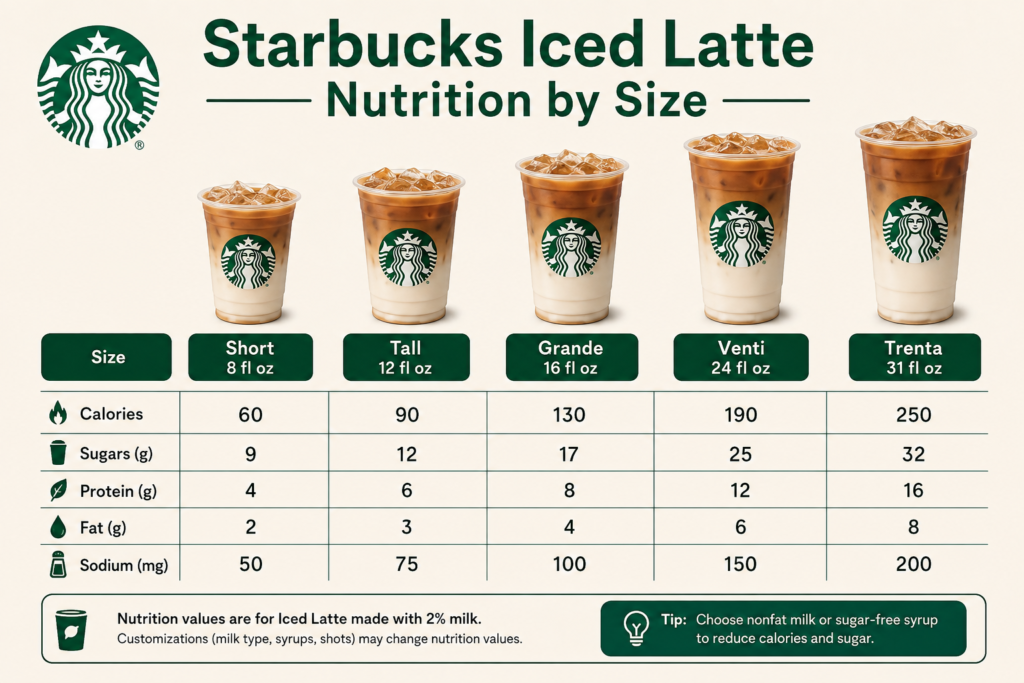
Tall (12 fl oz)
The smallest iced size available for this drink, the Tall comes with a single espresso shot and roughly two-thirds the milk of a Grande. With 2% milk, it delivers 100 calories, 3.5 grams of fat, 10 grams of carbohydrates, 9 grams of sugar, 6 grams of protein, and about 75 mg of caffeine. It’s the lowest-calorie and lowest-caffeine option among the three sizes, making it a reasonable choice if you want the flavor of an iced latte without a large calorie or caffeine load.
Grande (16 fl oz)
The most commonly ordered size, the Grande uses two espresso shots and sits at the midpoint of the nutrition range: 130 calories, 4.5 grams of fat, 13 grams of carbohydrates, 11 grams of sugar, 8 grams of protein, and about 150 mg of caffeine with 2% milk. Most of the milk-comparison and customization data available for this drink, including Starbucks’ own default menu display, centers on the Grande size.
Venti (24 fl oz)
The largest iced size, the Venti holds three espresso shots and roughly double the milk of a Tall. With 2% milk, it comes in at 180 calories, 6 grams of fat, 18 grams of carbohydrates, 15 grams of sugar, 12 grams of protein, and about 225 mg of caffeine. It’s worth noting that Venti cold drinks (24 fl oz) are a different size than Venti hot drinks (20 fl oz) at Starbucks — the extra volume in the iced version is part of why its nutrition numbers scale up a bit more than a simple size-ratio comparison might suggest.
How Milk Choice Changes Starbucks Iced Latte Nutrition
Milk selection is the single biggest nutritional decision you make when ordering an Iced Caffè Latte, more consequential than syrup or topping choices for most customers. Starbucks currently offers several milk options for this drink, including nonfat, 2%, whole, soymilk, oatmilk, almondmilk, coconutmilk, and a protein-boosted milk, along with breve (half-and-half) for a richer version. Not every option carries identical published nutrition data, and availability can vary slightly by market, so the table below focuses on the milks with clearly documented figures for the Grande size.
| Milk (Grande) | Calories | Fat | Carbs | Sugar | Protein |
|---|---|---|---|---|---|
| Nonfat milk | 90 | 0 g | 13 g | 11 g | 8 g |
| 2% milk (default) | 130 | 4.5 g | 13 g | 11 g | 8 g |
| Whole milk | 150 | 7 g | 13 g | 11 g | 8 g |
| Soymilk | 130 | 3.5 g | 17 g | 12 g | 7 g |
| Coconutmilk | 90 | 5 g | 10 g | 8 g | 1 g |
A few practical takeaways from this comparison. If you’re trying to minimize fat without sacrificing much protein, nonfat milk is the clearest option — it matches 2% and whole milk on protein while removing essentially all the fat. If you’re avoiding dairy, soymilk is the closest plant-based match on protein, though it runs slightly higher in carbohydrates. Coconutmilk keeps calories relatively low but delivers very little protein and a fat profile that’s almost entirely saturated fat, so it’s not a like-for-like swap for dairy nutritionally even though the calorie count looks similar to nonfat.
Oatmilk and almondmilk are also popular choices for this drink, but Starbucks’ published nutrition figures for these specific plant milks in the iced latte context vary more across sources than the milks listed above, so exact numbers aren’t included here. As a general rule, both tend to be lower in protein than dairy or soy, and oatmilk in particular tends to run higher in carbohydrates than other plant milks due to how oats are processed. If exact figures matter for your tracking, checking the nutrition calculator in the Starbucks app for your specific order is the most reliable way to get current numbers for these milks.
Starbucks Iced Latte Nutrition With Customizations
Because the base Iced Caffè Latte recipe is so simple, almost any customization has a proportionally larger effect on its nutrition than the same customization would have on a drink that’s already sweetened or higher in calories. A few common examples of how customization changes the nutrition profile:
- Flavored syrups (vanilla, caramel, hazelnut, and similar) add sugar, carbohydrates, and calories per pump, with no meaningful change to fat or protein. The exact amount depends on the syrup and number of pumps, which Starbucks adjusts by size.
- Sugar-free syrup, where available, adds flavor with minimal to no additional sugar or carbohydrates compared to the plain drink, though it typically still adds a small number of calories.
- Milk substitutions, as covered above, are the biggest single lever for changing fat, protein, and carbohydrate content.
- Extra espresso shots add caffeine (roughly 75 mg per shot) and a small number of additional calories, with negligible change to fat, sugar, or protein.
- Cold foam adds calories, fat, and a small amount of protein and sugar, since it’s made from milk whipped to a foam consistency; sweetened or flavored cold foams add more sugar than plain versions.
- Whipped cream, where added to an iced latte, contributes calories, fat (including saturated fat), and a small amount of sugar, with no meaningful protein contribution.
We haven’t listed exact gram or calorie figures for every syrup and topping combination here, since those numbers are covered in more detail on our dedicated calorie guide and can be checked precisely using the Starbucks nutrition calculator, which lets you build your exact order and see the totals update in real time.
Is a Starbucks Iced Latte a Low-Calorie Drink?
There’s no single correct answer to this, because it depends entirely on how you order it. A plain Tall Iced Caffè Latte with nonfat milk and no syrup is genuinely one of the lower-calorie espresso drinks on the menu. A Venti version with whole milk, multiple pumps of syrup, and whipped cream is a meaningfully different drink nutritionally, even though both are technically “an iced latte.”
Rather than labeling the drink as universally healthy or unhealthy, it’s more useful to think of the base recipe as a flexible starting point. The plain version, especially in a Tall or Grande with a lighter milk, tends to compare favorably to many other Starbucks espresso drinks on calories, sugar, and fat, largely because it has no built-in sweetener. From there, every customization is a deliberate choice that shifts the numbers in a specific, predictable direction, which is exactly why checking the nutrition information before you order — rather than after — is the most useful way to use this data.
How to Order a Lower-Calorie Starbucks Iced Latte
A few practical adjustments, in roughly the order of impact:
- Choose a smaller size. Since calories scale closely with milk volume, moving from a Venti to a Grande or Tall is the single biggest lever available.
- Switch to a lower-fat milk. Nonfat milk removes the most calories from the fat side of the equation while keeping protein intact.
- Skip or reduce syrup. Each pump of flavored syrup adds calories on top of the base drink; fewer pumps or a sugar-free option reduces that addition.
- Skip whipped cream or cold foam, or ask for a lighter portion, since both add calories primarily through fat and sugar.
- Compare your exact order before ordering using a tool like the Starbucks app or our Starbucks calorie calculator, which accounts for size, milk, and add-ins together rather than one variable at a time.
None of these are medical recommendations — they’re simply how the nutrition numbers respond to common order changes. What fits your goals is a personal decision.
How to Order a Lower-Sugar Iced Latte
It’s worth separating two different kinds of sugar in this conversation. The sugar naturally present in milk (lactose) is part of the base recipe and doesn’t change unless you change your milk type or amount. Added sugar comes from syrups, sauces, and sweetened toppings layered on top of the base drink.
A plain Iced Caffè Latte, with any milk, has zero added sugar — everything on the label is naturally occurring. If you want to keep it that way while still adding flavor, sugar-free syrup (where available for your chosen flavor) is the most direct option, since it’s formulated to add taste without adding sugar or meaningfully changing the carbohydrate count. If you do want a regular flavored syrup, asking for fewer pumps than the default reduces the added sugar roughly in proportion to how many pumps you remove. Keep in mind that milk choice still affects the “natural sugar” baseline you’re starting from, so the final total depends on the whole order, not just the syrup decision alone.
Starbucks Iced Latte vs Other Starbucks Coffee Drinks
For context, here’s how a Grande Iced Caffè Latte compares to a few other popular Starbucks iced coffee drinks, based on Starbucks’ published nutrition information for their standard recipes:
| Drink (Grande) | Calories | Sugar | Protein | Caffeine |
|---|---|---|---|---|
| Iced Caffè Latte (2% milk) | 130 | 11 g | 8 g | 150 mg |
| Iced Caffè Americano | 15 | 0 g | 1 g | 225 mg |
| Cold Brew (unsweetened) | 5 | 0 g | 1 g | 205 mg |
| Iced Coffee (unsweetened) | 5 | 0 g | 0 g | 165 mg |
The pattern here comes down to milk volume. An Iced Americano and Cold Brew both contain little to no milk by default, which is why their calorie, sugar, and protein numbers stay near zero while their caffeine content is actually higher than a Grande Iced Caffè Latte’s — Cold Brew and Americano use more concentrated espresso or brewing methods without the dilution of milk. The iced latte, by contrast, trades some of that caffeine-per-ounce for a creamier drink with meaningfully more protein and calories, largely because of the milk itself. Neither approach is inherently better; they simply serve different preferences.
How to Read Starbucks Nutrition Information
Starbucks’ nutrition labels follow the same basic structure as any packaged food label, and understanding a few terms makes the numbers more useful:
- Calories measure total energy in the drink, from all sources combined (fat, carbohydrate, and protein each contribute calories).
- Total fat includes all fat in the drink; saturated fat is a subset of that total and is generally the fat type most people track separately, since dietary guidelines often recommend limiting it.
- Total carbohydrates includes sugar and fiber together; a drink with 13 g of carbs and 11 g of sugar, for example, has very little fiber or starch beyond that sugar content.
- Sugars on a Starbucks label may include both naturally occurring sugar (like lactose from milk) and added sugar (from syrups); where the two aren’t broken out separately, you generally have to infer the source from the drink’s recipe, as this article has for the plain iced latte.
- Protein reflects the drink’s contribution to your daily protein intake, coming primarily from milk in this drink.
- Caffeine values are approximate, since natural variation in beans and brewing means exact caffeine content isn’t perfectly consistent cup to cup.
Why Starbucks Nutrition Numbers Can Change
Nutrition figures for any Starbucks drink aren’t permanently fixed. A few reasons the numbers you see today might shift over time:
- Recipe updates. Starbucks periodically reformulates syrups, sauces, or standard recipes, which can change calorie or sugar counts even for a drink you’ve ordered the same way for years.
- Milk substitutions. Simply switching your milk type changes nearly every number on the label, as shown in the comparisons above.
- Size. Larger sizes use more milk and more espresso shots, scaling most nutrition values up accordingly.
- Customization. Syrups, sauces, whipped cream, and cold foam are all optional add-ins that shift the base numbers.
- Regional differences. Starbucks operates under different suppliers and, in some cases, different recipes by country. U.S. nutrition figures should not be assumed to match Starbucks UK, Canada, or other international markets exactly.
Because of this, treat any specific number in this article — including the tables above — as a snapshot rather than a permanent fact, and check Starbucks’ official nutrition information directly if you need figures for a specific date or location.
Final Takeaway
A Starbucks Iced Caffè Latte’s nutrition isn’t a single fixed number — it’s a starting recipe that shifts meaningfully with size, milk choice, and customization. The base drink, especially in a smaller size with a lighter milk, tends to be one of the more moderate options on the espresso menu across calories, sugar, and fat, while still offering more protein than most other iced coffee drinks thanks to its milk content. Caffeine scales with espresso shots rather than cup size, so it’s worth checking separately from the other numbers if that’s your main concern.
Because these figures can shift with recipe updates, milk swaps, and regional differences, it’s worth checking current official Starbucks nutrition information for your specific order, especially if you’re tracking numbers closely. For a closer look at calories specifically — by size, by milk, and by common customizations — see our detailed Starbucks iced latte calories guide, or build your exact order in our Starbucks nutrition calculator to see live totals for calories, sugar, protein, carbs, fat, and caffeine together.
Frequently Asked Questions
How many calories are in a Starbucks iced latte? A standard Iced Caffè Latte with 2% milk has 100 calories in a Tall, 130 in a Grande, and 180 in a Venti. These numbers change with milk type and any added syrups or toppings.
How much sugar is in a Starbucks iced latte? With no added syrup, sugar comes entirely from natural milk sugar (lactose): 9 g in a Tall, 11 g in a Grande, and 15 g in a Venti with 2% milk. Adding flavored syrup increases this total.
How much protein is in a Starbucks iced latte? A 2% milk Iced Caffè Latte provides 6 g of protein in a Tall, 8 g in a Grande, and 12 g in a Venti. Dairy and soy milk options generally provide more protein than most plant-based alternatives like almondmilk or oatmilk.
How much fat is in a Starbucks iced latte? Total fat ranges from 3.5 g in a Tall to 6 g in a Venti with 2% milk. Nonfat milk removes nearly all of this fat, while whole milk and coconutmilk increase it.
How much caffeine is in a Starbucks iced latte? Caffeine is approximately 75 mg in a Tall (1 shot), 150 mg in a Grande (2 shots), and 225 mg in a Venti (3 shots), based on Starbucks’ standard recipe.
Is an iced latte healthier than an iced coffee? They’re nutritionally different rather than simply “healthier” or “less healthy.” A plain Iced Coffee or Cold Brew has fewer calories, less sugar, and slightly more caffeine per ounce, since it contains little to no milk. An Iced Caffè Latte has more calories and sugar from milk, but also considerably more protein. Which is the better fit depends on what you’re looking for from the drink.
Which Starbucks milk has the fewest calories? Among the options with clearly documented figures for the Grande Iced Caffè Latte, nonfat milk and coconutmilk both come in at 90 calories, the lowest of the milks compared in this guide. They differ significantly in fat and protein content, though, so “fewest calories” isn’t the only factor worth considering.
Can I customize a Starbucks iced latte to reduce calories? Yes. Choosing a smaller size, switching to a lower-fat milk, reducing or skipping syrup, and skipping whipped cream or cold foam are all customizations that lower the total calorie count, in roughly that order of impact.
Nutrition data in this article reflects Starbucks’ published U.S. nutrition information as of August 2026. Figures are provided for general informational purposes and are not medical or dietary advice. Because Starbucks recipes and customizations can change, verify current values through the Starbucks app or starbucks.com before relying on them for medical or dietary decisions.
U.S. Starbucks menu data. Figures reflect Starbucks’ published nutrition information for the standard Iced Caffè Latte and are current as of August 2026. Because Starbucks updates recipes and customers frequently modify their orders, always check the Starbucks app or starbucks.com for the most current numbers on your specific order.